

Neither setting wins for every toddler. Center-based ABA and in-home ABA are two delivery formats families may encounter when planning early autism support. A clinic or classroom-style program can create more chances for peer practice and group routines. In-home sessions can embed goals in meals, dressing and bedtime. The better fit depends on your child’s goals, your family’s week and what each program can actually provide. This guide is general education for Maryland families. It is not a care plan, a diagnosis or a promise about outcomes. Your child’s Providers should help you decide.
Key takeaways
- Research does not crown one ABA setting as best for every toddler. Match the setting to the skills you want to practice.
- Center-based programs often make peer play, circle time and group directions easier to rehearse.
- In-home ABA can teach communication and self-help inside the routines where your child already lives.
- Skills learned in one place often need planned practice in other places, with other people and materials.
- A hybrid week is sometimes an option when goals span both peer practice and home routines, and when authorization allows it.
- Ask Providers for measurable goals, generalization checks and clear answers about staffing, hours and insurance place-of-service rules.
Which ABA setting fits your toddler?
When you weigh center-based ABA against in-home ABA for a toddler, the honest answer is that there is no single winner. Direct head-to-head research is limited, and results vary by child, intensity, coaching quality and how carefully skills are practiced across settings. Treat marketing claims with caution. Ask how each program measures progress and carryover, not only how many hours it offers.
Center-based days can include classroom-style routines that resemble preschool. In-home days can use your kitchen, bathroom and playroom as the teaching context. Sibling play can support socialization at home, and structured social skills and school-readiness practice can support peer goals in a program. As kindergarten nears, ask how progress will be summarized for your child’s school team. Our guide to a medical autism diagnosis vs. Maryland school IEP eligibility explains why clinical and school paperwork are different.
Center-based vs. in-home ABA at a glance
Use this table as a starting point for questions. Programs vary widely, so treat each cell as a common pattern rather than a rating.
| Factor | Center-based ABA (general) | In-home ABA (general) |
|---|---|---|
| Peer access | Often includes same-age peers and planned peer practice; details vary by program | Usually caregivers and household members; peer practice may need to be arranged separately |
| Group routines | Many programs include circle time, group directions and shared activities | Harder to stage full group routines at home; some skills can still be practiced one-to-one |
| Everyday routines | Classroom-style routines may be practiced; home carryover still needs planning | Meals, dressing, bath and bedtime can be the teaching context |
| Caregiver coaching | Often scheduled as parent training; day-to-day coaching varies | Coaching can happen inside your family’s real routines |
| Travel and schedule | Fixed program hours and a commute are common | No commute; protected time at home is still needed |
| Related therapies | Some programs coordinate speech, OT and behavioral support; ask what is on site | Speech, OT and ABA may be scheduled with separate Providers |
| Generalization | Skills learned in a clinic often need planned practice at home and in the community | Skills are practiced where they are used; transfer across people and places still needs checking |
| Hours | Weekly hours are individualized; ask about half-day, full-day or session-based options | Weekly hours are individualized; ask what your authorization and plan allow |
Inside a center-based ABA toddler program
From the doorway, a center-based toddler day often looks like a structured preschool: arrival and free play, opening circle, snack, teaching blocks, outdoor or movement time and a closing routine. Underneath, a clinical program plans those routines around assessment results and an individualized treatment plan.
- Ask who oversees the plan (for example, a BCBA) and who works with your child session to session.
- Ask how one-to-one teaching and naturalistic teaching are blended during meals, play and transitions.
- Ask whether speech-language therapy or occupational and sensory therapy are coordinated with the ABA plan, on site or by referral.
Weekly hours and program length should be individualized. Some families encounter half-day mornings; others encounter longer schedules. There is no single correct number of hours for every toddler. Blue Sails offers ABA and related autism supports through an early-intervention autism program for children ages 2 to 6, along with evaluations and parent coaching. Program options and locations vary, so ask intake what is available for your family. For a related comparison of a structured day program and traditional childcare, see early-intervention day program vs. daycare.
Peer social skills in a center-based setting

Social skills grow through real interactions, not drills alone. When same-age peers share the room, Providers can use peer-mediated approaches: teaching classmates to model, prompt and respond to your child’s communication. Peer practice can target both initiating and responding, which sit at the core of reciprocal play.
Peer access creates opportunity. It does not promise identical results across programs. Ask how adults coach play, how group size is chosen and how progress is measured. ADHD and autism can co-occur in young children, so careful assessment matters when attention, impulsivity or hyperactivity are part of the picture. A comprehensive evaluation may combine behavioral observation with caregiver interviews and rating scales. Blue Sails offers autism evaluations, including pathways that may use the ADOS-2 when clinically appropriate.
Circle time and group routines

Circle time adds practice that a living room rarely replicates: sitting with peers, attending to a shared activity and responding to group directions through greetings, songs and simple group jobs. Quality matters. Engagement drops when adults do all the talking, so ask about group size, how often circle happens and how Providers draw out your child’s own responses.
Movement breaks, visual supports and AAC can help toddlers participate in their own way. Related motor and sensory supports may help some children join group routines more comfortably. County early intervention and school preschool services can complement clinic-based practice; ask how teams will share strategies with your permission.
Preschool transitions rehearsed in structured programs
Shifts often trip toddlers up more than the activities themselves: cubby to circle, playdough to handwashing, a favorite toy to whatever comes next. Structured programs often rehearse arrival steps, departure cues, waiting, “first–then” language and simple ways to request a break or help. Visual schedules help many children, but they work best when paired with consistent teaching rather than used alone.
Parent coaching can help families use the same cues at home. When your child is near preschool age, ask how goals will map onto school routines and whether the team can help you prepare questions for an IEP or IFSP meeting. Our autism and early intervention guide covers earlier steps.
For a step-by-step look at the skills that often matter before the first day of school, see what kindergarten readiness can look like for a child with autism.
Why center skills need practice at home too
When a toddler shows a new skill in a clinic or classroom-style room—asking for a snack, washing hands, waiting for a turn—it is tempting to assume the skill will appear at home on its own. It often does not, at least not right away. Clinicians call this generalization: using a skill with different people, materials, settings and at later times.
Skills practiced in a structured program may not automatically transfer to bedtime or a grandparent’s house. Planned home practice across people, materials and routines helps a toddler use new words and self-help steps with siblings, caregivers and you—not only with session staff. Federally supported early intervention guidance emphasizes learning in natural environments: the everyday places, people and routines where skills will be used. Family well-being matters too; supporting a child works best when caregivers have realistic pacing and support.
What in-home ABA therapy does well
In-home ABA often shines in everyday moments a clinic cannot fully replicate: snack time, bath time and bedtime. When Providers coach you inside those routines, you can prompt requests and reinforce skills between sessions, not only during them. Below is what that can look like in practice: teaching within your family’s real rhythms, building caregiver confidence and helping your child use skills where they need them.
Teaching in everyday routines
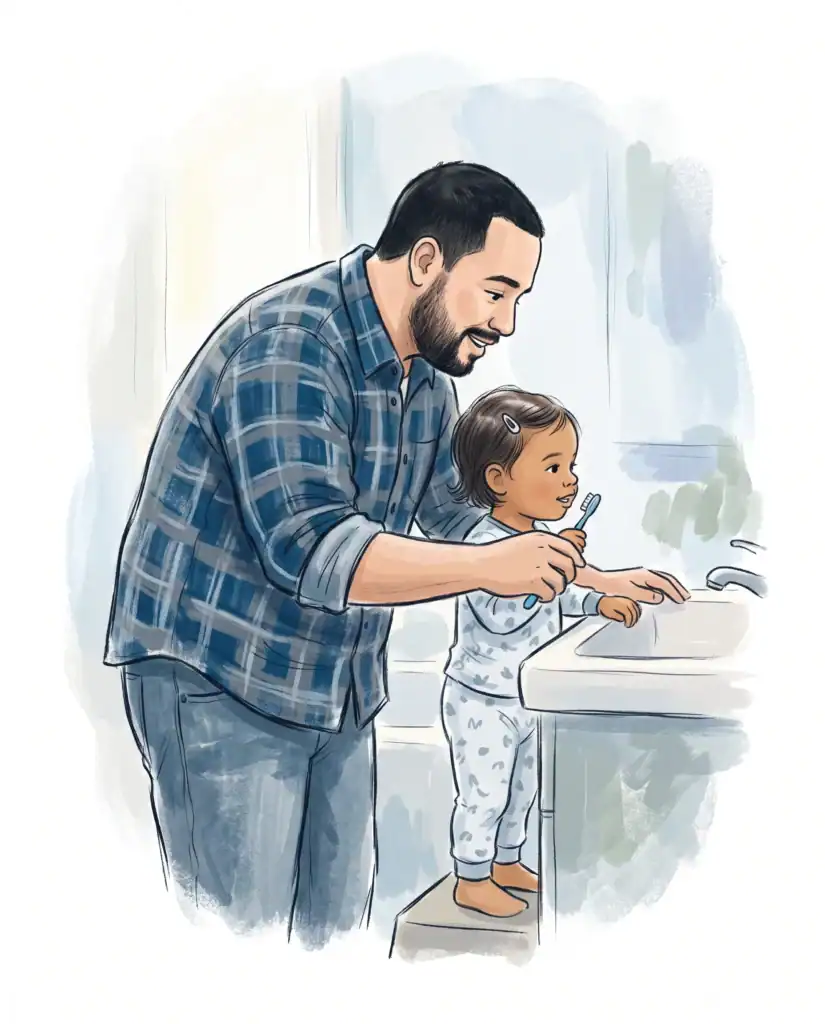
Learning often sticks when it happens where your child already lives—at the kitchen table, at the sink while brushing teeth, on the floor with familiar toys. In-home ABA can embed targets into play, meals and dressing using modeling, prompting, shaping and reinforcement during functional activities. Following your toddler’s interests, arranging materials to invite requests and pausing so your child has time to communicate are common strategies.
Everyday routines also create natural chances to practice joint attention and early social communication. Self-help skills can be broken into manageable steps with prompts faded toward independence. A child’s autism support level can inform planning, but goals should still reflect that child’s specific needs. Track whether skills transfer to different people and settings; acquisition alone does not ensure generalization.
Caregiver coaching between sessions
Your toddler spends far more waking hours with you than with any Provider. What happens between sessions matters. Caregiver coaching can combine instruction, modeling, your practice and feedback. Reviews of family-mediated interventions treat caregiver fidelity and child skill improvement as central goals; practice with feedback strengthens fidelity. Coaching takes commitment, and scheduling is not always easy. Ask for a realistic pace so coaching builds confidence rather than burnout.
Structured information about a condition and its treatment—sometimes called psychoeducation—can help families know what to expect. Parent coaching and training at Blue Sails focuses on practical strategies you can use at home. Parent support groups are not assumed here; ask intake what caregiver supports are currently available.
Practicing skills in context
Practicing a skill where it needs to work is a core strength of in-home ABA. Requests, turn-taking and transitions can be embedded into snack, dressing and play so communication happens during real moments. Natural environment teaching uses your child’s toys, rooms and routines as cues.
Generalization still needs checking rather than assuming. At 18- and 24-month well visits, pediatricians may use the M-CHAT-R/F to screen for autism. The ADOS-2 uses modules tailored to age and language level. Clinicians may also consider social reciprocity when distinguishing an isolated speech delay from autism. A school autism classification supports an IEP but is distinct from a medical autism diagnosis, which many insurers ask for before authorizing ABA.
Mealtime, play and bedtime as ABA teaching moments
Three familiar routines—mealtime, play and bedtime—give rich natural openings for teaching, with or without a formal therapy setup.
- Meals: Offer a choice between two foods or utensils, then pause briefly before handing over a requested item. Requests can use speech, signs, pictures or AAC. Break self-help steps into small pieces, starting at snack time.
- Play: Follow your child’s lead, add one new action and build turn-taking and imitation. Repeating a short routine gives multiple practice chances in a motivating context.
- Bedtime: Keep a predictable sequence—bath, pajamas, story, lights out—and use a visual strip so steps feel manageable.
Because ADHD and autism can co-occur, individualized assessment helps identify which supports fit a child’s profile. Support should reflect each child, not a one-size plan.
Why ABA parent training works well at home
When a BCBA works with your toddler for a few hours each week, that is meaningful structured learning—and still a small slice of the week. Parent training at home multiplies practice during snack, play and bedtime. Research on parent-implemented interventions has reported gains in caregiver strategy use and children’s communication, along with warmer parent–child interactions, though results vary and generalization is not automatic for every child. Pairing clinician-led ABA with caregiver coaching gives more chances to practice without promising a specific outcome.
When home distractions affect toddler ABA
Televisions, siblings, clutter and household activity can compete for a toddler’s attention during home sessions. Familiar surroundings help some children and distract others. You can arrange the environment: turn off screens, limit competing toys, keep sessions predictable and track engagement with your Provider. Distraction is one factor among many; it is not a verdict that home-based care cannot work.
Hybrid ABA: center days plus home coaching
A hybrid plan blends structured peer and group practice with everyday coaching at home. A clinician may discuss hybrid options when goals span both settings and when authorization allows split hours. Center sessions can target group directions, waiting, transitions and peer play. Home coaching can teach prompting, reinforcement and prompt-fading during meals, bedtime and play.
Coordination matters. Ask who shares data across settings, how often caregivers meet and who adjusts strategies. Research on hybrid delivery remains limited, so treat it as one thoughtful pathway—not an automatic advantage—and individualize every plan.
Practical matters: scheduling, travel and insurance
Logistics shape your family’s week as much as developmental goals. Center-based programs often use a fixed schedule and a commute. In-home sessions can flex around natural rhythms, but they still need protected time. Travel burden can be significant for some Southern Maryland families.
Coverage follows the service and your plan’s rules, not the label on the building. Place-of-service rules, networks and prior authorization details vary. Maryland Medicaid covers medically necessary ABA for eligible members under 21 under state rules (Maryland Department of Health). TRICARE has its own ABA coverage rules (TRICARE). Blue Sails accepts TRICARE for covered services generally; other coverage varies by plan and service. Before you commit, ask whether your authorization specifies a setting, a weekly hour range or specific codes. See insurance and billing for current practice details, and confirm benefits with your plan’s member services.
What to ask your Provider before you choose
Bring these questions to intake or a tour:
- What is the adult-to-child ratio during one-to-one and group time, and how is peer play coached?
- If a hybrid plan is possible, how is data shared between teams, and who adjusts strategies?
- What generalization measures do you track, and how often do you check transfer across people and places?
- How often is the treatment plan reviewed, and what happens if a goal is not met?
- How will progress be summarized if my child transitions to a public-school program?
- What is the assessment-to-start timeline, and are interim caregiver-coaching options available while waiting?
- Which insurance plans and place-of-service rules do you accept for each setting?
A strong program answers with specifics. Vague assurances are a signal to keep asking.
When to choose center-based, in-home or hybrid
Match the setting to the goal.
In-home ABA may fit when:
- Primary goals are communication and self-help during meals, dressing, bath and bedtime.
- Your toddler learns well with familiar caregivers and household materials.
- Travel or a fixed center schedule does not fit your week.
- You want coaching embedded in daily routines.
A center-based program may fit when:
- Peer socialization, circle time and group-direction skills are priorities.
- Your toddler needs a more structured, lower-distraction teaching environment for foundational skills.
- Coordinated speech, OT and behavioral support would reduce scheduling burden—if the program actually offers that coordination.
- School-readiness routines need rehearsal with peers.
A hybrid plan may fit when:
- Goals span both natural-routine communication and peer or group skills.
- Authorization allows split hours across settings.
- Your family can support consistent strategies across both environments.
Your BCBA and care team should build an individualized plan around your family’s priorities. Neither setting wins universally. Learn more about support for toddlers and preschoolers and autism services at Blue Sails, including the early-intervention autism program. When you are ready, request an appointment and intake can talk through clinical fit, current availability and what your insurance requires.
How to tell if the setting is working
Choosing a setting is only the first decision. The real question is whether skills change once therapy begins. Judge progress against data, not only impressions. Every goal should be observable and measurable, with a baseline before teaching starts. Ask whether skills generalize: does your toddler request snacks at Grandma’s, not only in sessions?
Watch for functional communication, spontaneous play and smoother shifts in group routines. Share home and preschool observations. Reassessment timing should be individualized rather than locked to a fixed calendar. Both settings can work; the evidence for your child, not the location label, tells you whether the plan needs to change.
If you are worried about your child’s or your own immediate safety, call 911, go to the nearest ER, or call or text 988.
Frequently asked questions
Does my toddler need a formal autism diagnosis before starting ABA?
Many insurers ask for a clinical autism diagnosis before authorizing ABA, but requirements vary by plan and state. Some early intervention pathways serve eligible children under three without that diagnosis. Check your insurer and ask Blue Sails intake what records your child’s services require.
Does insurance cover both center-based and in-home ABA?
Coverage varies by plan, place of service, network rules and prior authorization. Do not assume parity between settings. Blue Sails can help verify benefits; confirm details with your plan’s member services before care begins.
How many hours of ABA will my toddler need each week?
Hours should be individualized. They depend on goals, tolerance, caregiver capacity and what your authorization allows. There is no single correct weekly number for every toddler.
Is there usually a wait to start center-based ABA?
Availability varies by provider and season. Ask each program about its assessment-to-start timeline, cancellation lists and whether interim caregiver coaching is available while you wait.
Can we switch settings later if our toddler’s needs change?
Often yes, but a change usually needs clinical review, an updated treatment plan and payer authorization. Ask how the team handles documentation and continuity if a move is clinically appropriate.
Can center-based and in-home ABA be combined?
Sometimes. A hybrid week can make sense when goals span peer practice and home routines and when authorization allows split hours. Ask who coordinates data and strategies across settings.