
If your toddler isn’t talking as much as other children their age, it’s natural to wonder whether this is a speech delay or an early sign of autism. Many toddlers who talk late are not autistic, and a child can also have both. When clinicians sort out the difference, they look past word counts to how your child connects and communicates: whether they point to share something, follow your gaze, use gestures, understand what you say and enjoy back-and-forth play. This guide explains those signs, the red flags by age, and what screening, evaluation and early intervention involve. It is general education, not a diagnosis, and it does not replace a conversation with your child’s pediatrician. If you are worried about your child’s immediate safety, call 911 or go to the nearest ER. If you are in crisis yourself, call or text 988.
Key takeaways
- A speech or language delay mainly affects how a child uses or understands words. Autism involves differences in social communication, such as pointing to share interest and shared attention, together with restricted or repetitive behaviors.
- Clinicians pay close attention to joint attention and gestures. A late talker who points, shows you things and looks back to check your reaction is giving important information.
- A widely used set of criteria for late language emergence is fewer than 50 words and no two-word combinations by 24 months (ASHA).
- A hearing check is a common early step whenever language is delayed.
- You don’t need a diagnosis to ask for help. In Maryland, children under 3 may be eligible for the Infants and Toddlers Program based on developmental concerns.
Speech delay vs. autism: key differences at a glance
Every child is different, and no single sign settles the question. The table below summarizes general patterns clinicians consider. It is a starting point for a conversation with your child’s doctor, not a checklist for diagnosis.
| Area | Often seen with a speech or language delay alone | Can be a sign of autism |
|---|---|---|
| Social interest | Seeks out people and enjoys back-and-forth games | Less interest in shared play or in sharing enjoyment |
| Gestures | Uses pointing, waving and showing to make up for missing words | Few gestures, or pointing mainly to get something rather than to share |
| Joint attention | Follows your point and looks back to check your reaction | Rarely follows your gaze or brings things to show you |
| Response to name | Usually turns when called (once hearing is confirmed) | Often doesn’t respond, even when hearing is typical |
| How words are used | Fewer words, but used to connect with people | Words or phrases repeated over and over, or used less to communicate |
| Play and behavior | Varied and pretend play that grows over time | Repetitive play, movements or routines, or strong reactions to sounds and textures |
What “late talker” actually means
The American Speech-Language-Hearing Association (ASHA) describes late language emergence as a delay in language onset with no other diagnosed disabilities or delays in cognitive or motor development. Toddlers with late language emergence are often called “late talkers.” Some have expressive delays only, meaning they understand well but say less. Others have mixed expressive and receptive delays, meaning both understanding and speaking are behind (ASHA).
ASHA notes that a widely used set of criteria is an expressive vocabulary of fewer than 50 words and no two-word combinations by 24 months, and that these criteria should be reviewed at regular intervals to see how language is growing. ASHA also lists autism spectrum disorder and hearing loss among the conditions to consider when a child talks late, which is why clinicians look at your child’s whole development rather than speech alone. Our guide to the early signs of autism at 18–24 months covers the broader milestones to watch.
Gestures and joint attention

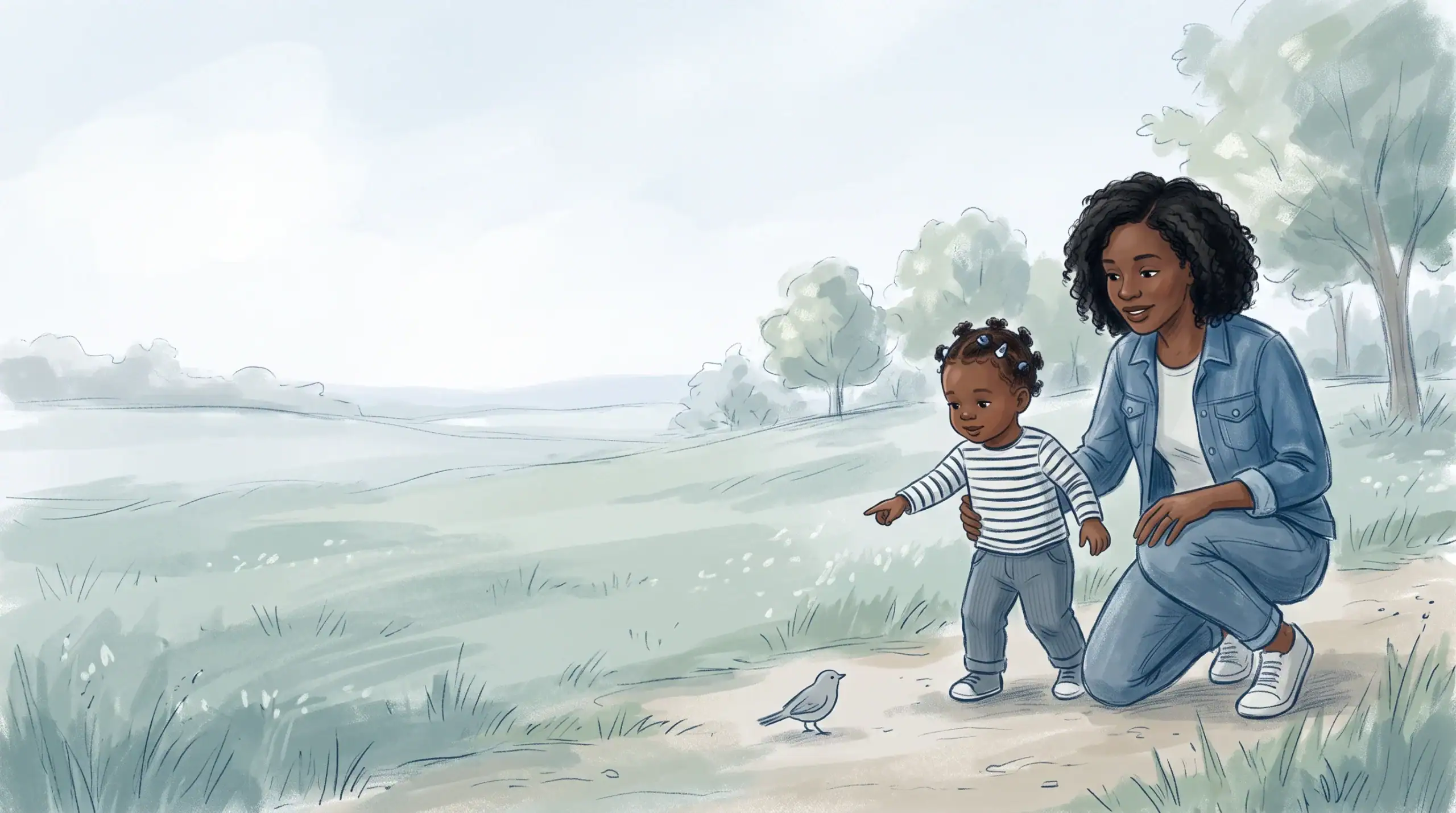
Joint attention is the moment you and your child look at the same thing and both know you’re sharing it. Your toddler points at a dog, looks back at your face, and waits for you to react. For many clinicians, this is one of the first places to look, because children with a speech delay alone often use gestures and eye gaze to make up for missing words.
The CDC lists examples of social-communication differences linked with autism, including using few or no gestures by 12 months, not sharing interests with others by 15 months (such as showing you an object they like), and not pointing to show you something interesting by 18 months (CDC). Clinicians also notice the purpose of a point. Pointing to request a snack is useful, but pointing to share something interesting with you tells a clinician more about social connection.
A late talker who waves, shows you toys, brings you books and checks your face during play is showing strong social communication, even with few words. A toddler who rarely points, seldom follows where you look and doesn’t bring things to share may benefit from a closer look, whether or not they have words. Signs can also be quieter in some girls, who may copy the play and gestures of others; read more about how autism presents differently in girls.
Does your toddler understand more than they say?
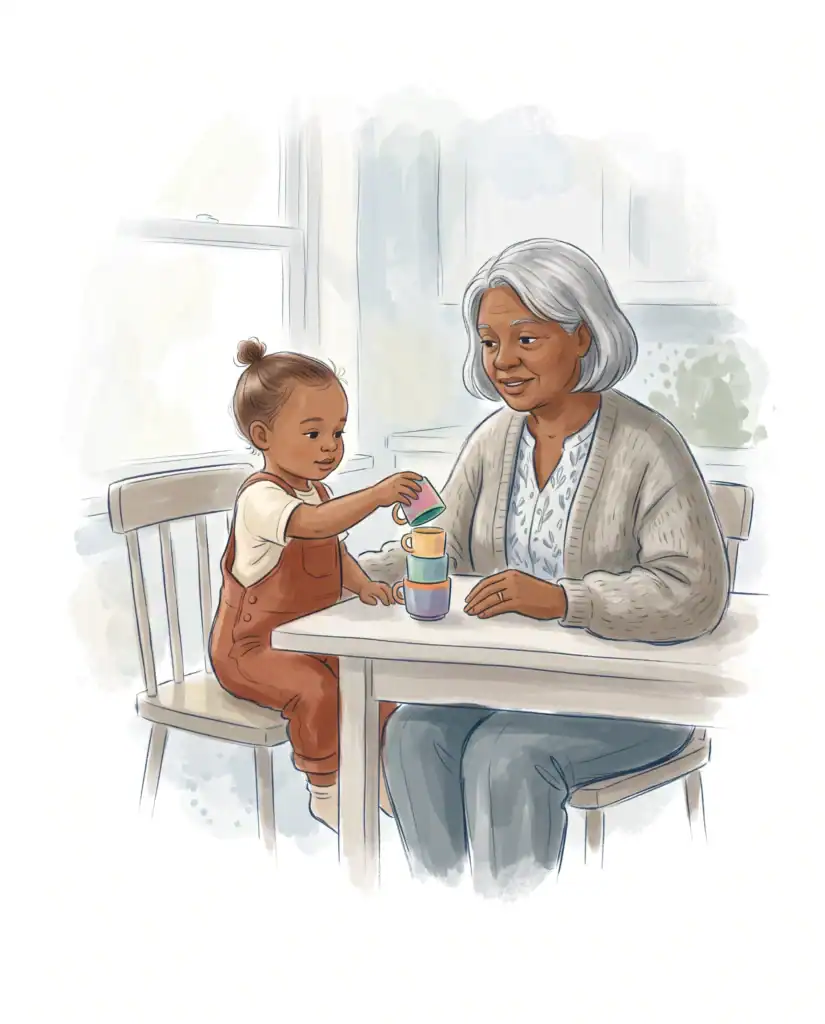
Receptive language is what your child understands. During an evaluation, clinicians often look at whether a toddler understands familiar words and follows simple directions, like “get your shoes” or “give it to Daddy,” without gestures to help. ASHA lists receptive vocabulary and comprehension of simple commands among the areas assessed in children who talk late (ASHA).
At home, you can notice whether your child turns toward a named object, finds a toy you ask for, or reacts to familiar phrases in everyday routines. Strong understanding with few spoken words is a different picture from limited understanding plus few gestures. Both are worth sharing with your child’s doctor, and a speech and language evaluation can clarify which picture fits.
Echolalia and how words are used
Some toddlers repeat words or phrases they have heard, sometimes right away and sometimes later, like a line from a show. This is called echolalia, and the CDC lists repeating words or phrases over and over among behaviors linked with autism (CDC). Repeating words is also part of how many young children learn language, so on its own it doesn’t mean a child is autistic.
Clinicians look at how your child uses words, not only how many. Do they use words to get your attention, comment on something, or answer a question? Or are most words repeated without a clear communicative purpose? That pattern, alongside gestures and shared attention, gives a fuller picture.
Play and repetitive behaviors
Many toddlers line up toys or love the same book every night. Clinicians become more curious when play stays narrow over time, when a child becomes very upset by small changes, or when repetitive movements such as hand flapping, rocking or spinning happen often. Strong reactions to sounds, smells, textures or how things look can also be part of the picture. One behavior on its own is not a diagnosis. A pattern across communication, play and behavior is what matters.
Why a hearing check comes early
Hearing problems can look like a language delay or make one harder. A toddler who can’t hear speech clearly may be slow to respond to their name and slow to learn words. ASHA advises considering hearing loss when making a differential diagnosis for a child who talks late (ASHA). Even if your baby passed a newborn hearing screen, ask your pediatrician whether a hearing evaluation makes sense now. Ruling hearing in or out early helps everyone interpret the rest of the evaluation.
What if your family speaks more than one language?
ASHA notes that research does not support late language emergence being a result of learning two languages, and that switching to one language should not be advised as a response to a delay. A strong language model in any language helps build a foundation for others (ASHA). When you count your child’s words, include words in every language your family speaks, and tell the clinician which languages your child hears at home.
Red flags by age: what to raise with your child’s doctor
These examples come from CDC milestone and autism-sign resources. They are prompts for a conversation, not a diagnosis, and children develop across a range of ages.
- By 12 months: few or no gestures, such as not waving bye-bye, and not playing simple back-and-forth games like pat-a-cake (CDC).
- By 15 months: not sharing interests with you, such as showing you a toy they like.
- By 18 months: not pointing to show you something interesting. The CDC’s 18-month checklist includes trying to say three or more words besides “mama” or “dada” (CDC milestones by 18 months).
- By 2 years: not noticing when others are hurt or upset. Most children say at least two words together, like “more milk” (CDC milestones by 2 years).
- By 30 months: the CDC’s checklist includes saying about 50 words and putting two or more words together with one action word, like “doggie run” (CDC milestones by 30 months).
- At any age: losing words, gestures or social skills your child already had. Call your child’s doctor promptly.
When to ask about an autism evaluation
The American Academy of Pediatrics recommends that all children be screened for autism at 18 and 24 months, along with regular developmental surveillance, and that children be referred for a diagnostic evaluation when screening shows increased likelihood of a developmental condition (AAP). You don’t have to wait for a scheduled visit. Raise your concerns with your child’s doctor if you notice a speech delay together with few gestures, limited shared attention, little response to name, repetitive behaviors, or a loss of skills.
A screening questionnaire such as the M-CHAT-R/F shows whether an evaluation may help. It does not diagnose autism. If you’d like to understand that next step, our page on autism evaluations and diagnosis explains what to expect.
What a speech-language evaluation looks at
A speech-language evaluation for a toddler is usually play-based. It combines direct observation with what you share about your child at home. ASHA lists areas such as how a child communicates (requesting, greeting, commenting), expressive vocabulary in every language spoken, word combinations, receptive vocabulary, understanding of simple commands, gestures and play (ASHA). Looking at speech and social communication together helps separate a language delay from broader social-communication differences.
Blue Sails offers pediatric speech-language therapy for autistic children and children with early communication delays. Ask our intake team about current availability and the treating clinician.
What an autism evaluation involves
A diagnostic evaluation looks at development, communication, social interaction, play and behavior across settings. It usually combines a careful developmental history from you with direct observation of your child. Structured observation tools such as the ADOS-2 can be part of an evaluation, but no single test makes the diagnosis. The evaluator applies DSM-5-TR criteria and considers other explanations, including hearing and language differences. Our guide to autism and early intervention explains screening, evaluation and next steps in more detail. If your child’s evaluation includes the ADOS-2, see how to prepare your toddler and what the scores mean.
Start early intervention without a diagnosis

You don’t need to know whether your child is a late talker or autistic to ask for support. Under the federal Individuals with Disabilities Education Act (IDEA), each state runs an early intervention program for children from birth to age 3. In Maryland, that is the Infants and Toddlers Program, run locally in each county. A child under 3 may be eligible with a 25% delay in one or more areas of development, atypical development or behavior that is likely to lead to a delay, or a diagnosed condition with a high probability of causing a delay. Parents, health providers and others can make a referral to the Maryland Infants and Toddlers Program, and its evaluations and services are free to families.
Blue Sails offers an early-intervention autism program for children ages 2 to 6, along with parent coaching and training and other autism services for young children and their families. You can also read about our care for toddlers and preschoolers. Coverage varies by plan, service and provider, so see insurance and costs or request an appointment and our team can check your benefits.
Frequently asked questions
Can a toddler have both a speech delay and autism?
Yes. A speech or language delay and autism can occur together, and many autistic children also have delayed language. That’s why clinicians look at gestures, shared attention, understanding, play and behavior, not only how many words a child says.
Do late talkers catch up on their own?
Some late talkers catch up, but no one can reliably predict which children will. Waiting to see can delay support that might help. If you are concerned, talk with your child’s doctor and ask about a speech and language evaluation or an early intervention referral.
Does learning two languages cause a speech delay?
ASHA notes that late language emergence is not a result of learning two languages and that families should not be advised to drop a language because of a delay. Count words in every language your child uses when you share concerns with a clinician.
Does my toddler need a hearing test if they passed the newborn screen?
Possibly. Hearing problems can look like a language delay, and clinicians commonly check hearing when a toddler talks late. Ask your pediatrician whether a hearing evaluation makes sense for your child now.
Does insurance cover speech and autism evaluations?
Coverage varies by plan, service and provider, and some plans require a referral or prior authorization. Blue Sails autism services accept Maryland Medicaid and TRICARE, and our team can check your benefits before services begin. Maryland Infants and Toddlers Program evaluations and services are free to families.