
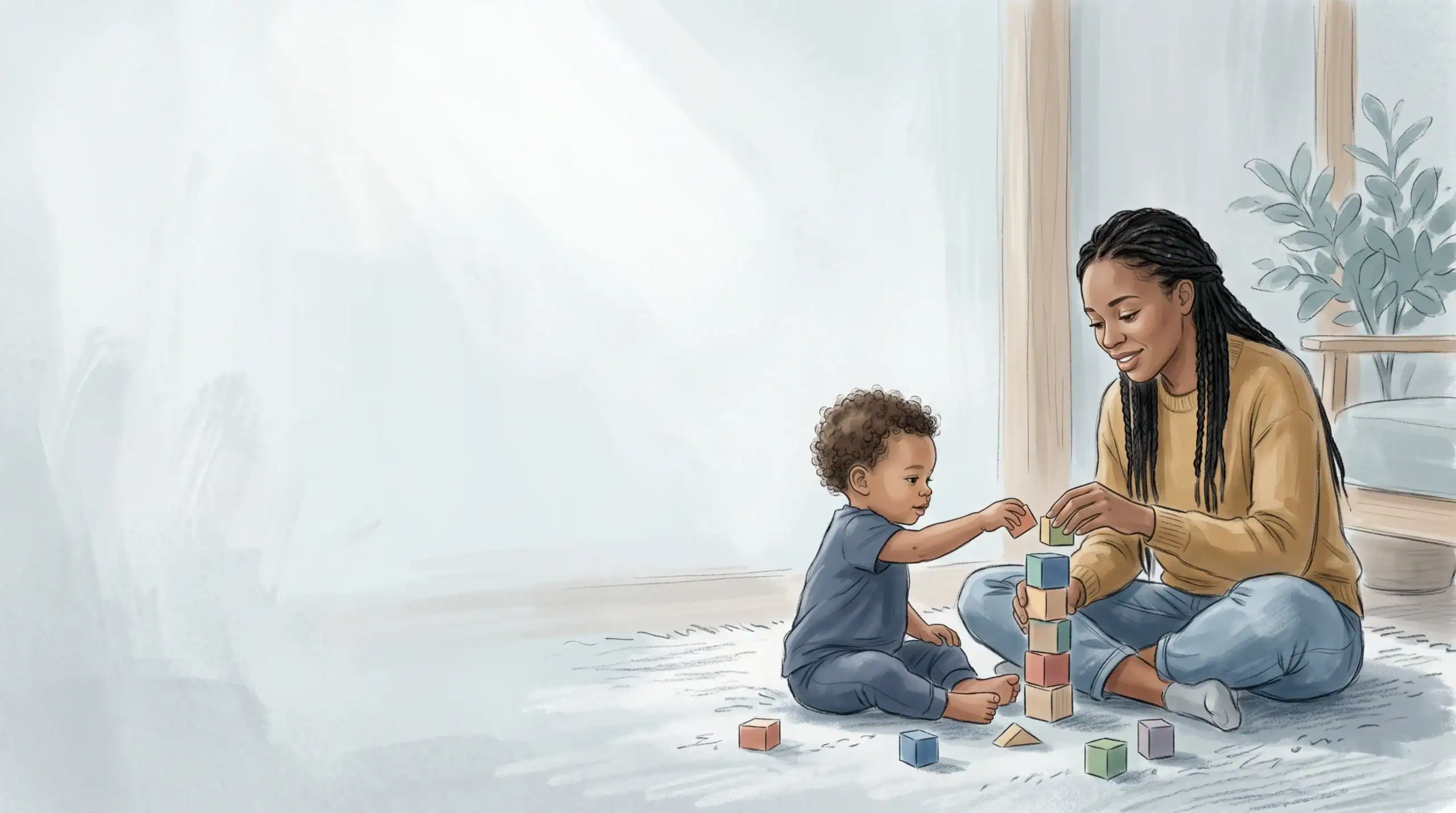
If your child’s doctor or an evaluator has recommended the ADOS-2, you probably have questions about what happens in the room, how to get your toddler ready and what the numbers on the report mean. This guide takes you inside the ADOS-2 assessment: what the observation is, how the modules work, how it is scored and how to make the day easier for your child. It is general education and does not replace advice from your child’s clinician. If you are worried about your child’s or your own immediate safety, contact 911, the nearest ER, or call or text 988.
Key takeaways
- The ADOS-2 is a play-based, standardized observation. Each module takes about 40 to 60 minutes, and your child receives only one module (Pearson Clinical).
- The Toddler Module is for children 12 to 30 months old who do not yet use phrase speech consistently. It reports a range of concern instead of a diagnostic classification (Luyster et al., 2009).
- There is nothing to study or rehearse. The goal is to see how your child naturally communicates and plays.
- The ADOS-2 is not a stand-alone diagnostic test. A clinician combines it with your child’s developmental history and other information (Thomas et al., 2021).
What is the ADOS-2?
The Autism Diagnostic Observation Schedule, Second Edition (ADOS-2) is a semi-structured, standardized assessment of communication, social interaction and play. The examiner sets up activities and materials designed to invite social and communication behaviors, then watches how your child responds and starts interactions (Thomas et al., 2021).
For young children, that usually looks like play: bubbles, a snack, toys that light up or move, and simple pretend play. The examiner notices things like how your child shares attention, responds to their name, uses gestures and eye contact, and plays with objects. The developers describe this as presenting “loosely structured and highly motivating materials and activities” to see how a child responds (Luyster et al., 2009).
ADOS-2 modules explained
The ADOS-2 has five modules. The examiner chooses one based on your child’s expressive language level and age, so the activities fit how your child communicates today (Pearson Clinical).
| Module | Who it is designed for |
|---|---|
| Toddler Module | Children 12 to 30 months old who do not consistently use phrase speech |
| Module 1 | Children 31 months and older who do not consistently use phrase speech |
| Module 2 | Children of any age who use phrase speech but are not verbally fluent |
| Module 3 | Verbally fluent children and young adolescents |
| Module 4 | Verbally fluent older adolescents and adults |
Source: Pearson Clinical ADOS-2 product information. If your child is close to a cutoff, the evaluator decides which module fits their communication on the day.
The ADOS-2 Toddler Module
The Toddler Module was added in the second edition for children 12 to 30 months old whose language ranges from no words to single words and simple phrases. Toddlers should be walking independently, and a nonverbal mental age of at least 12 months is recommended (Esler et al., 2015). The developers set the 12-month lower limit because, in early testing, children developmentally younger than 12 months tended to get elevated scores whether or not they were autistic (Luyster et al., 2009).
The Toddler Module looks at three areas: language and communication, reciprocal social interaction, and play along with restricted or repetitive behaviors and interests (Luyster et al., 2009).
What to expect at an ADOS-2 evaluation
Parents often ask about “ADOS test questions.” For a toddler, there are no questions to answer correctly. The examiner offers a series of playful activities, sometimes called social presses, and watches what your child does with them. Examples include blowing bubbles and pausing to see whether your child asks for more, offering a snack, rolling a ball back and forth, calling your child’s name and pretend play with a doll or toy animals.
You will usually stay in the room with a toddler. The examiner may ask you to join in for a few activities, such as calling your child’s name or playing a familiar game. The observation itself typically takes about 40 to 60 minutes (Pearson Clinical). A full evaluation usually includes more than the ADOS-2, so ask the evaluator how long the whole appointment will take.
Who can administer the ADOS-2?
The ADOS-2 is a clinician-administered tool, and valid use requires specific training. The publisher advises that users have prior education, training and experience with autism spectrum disorders, study the manual, complete a clinical training workshop or training program, and practice on cases outside formal evaluations until they are confident in administering and coding it (WPS ADOS-2 requirements). Toddler Module training is a separate workshop that builds on training for Modules 1 to 4 (Weill Cornell Medicine).
When you book, it is reasonable to ask who will complete the evaluation, what their credentials are and whether they are trained in the module your child will need. At Blue Sails, autism evaluations are completed with a PsyD clinician, and the ADOS-2 may be one part of the assessment.
How to prepare your toddler
The most helpful preparation is simple: help your child arrive as rested, fed and comfortable as possible. A few ideas:
- If you can, choose an appointment time that avoids your child’s usual nap.
- Keep the morning routine as normal as possible.
- Tell your toddler, in simple words, that you are going to a place with toys where a new grown-up will play with them.
- Do not practice eye contact, pointing or pretend play beforehand. The evaluator needs to see your child’s everyday communication, and rehearsed behavior is not part of the picture they are trying to see.
- Write down examples of what concerns you, and what your child does well, so you remember them on the day.
What to pack for your toddler’s appointment

Packing a small bag ahead of time can make the day calmer for you both. Consider bringing:
- A comfort item, such as a favorite blanket or stuffed animal.
- Familiar snacks and a drink your child already eats and drinks safely. Ask the office ahead of time whether food is okay during the visit.
- Diapers, wipes and a change of clothes.
- Any glasses or hearing aids your child uses.
- Medical and developmental records, prior evaluations, early intervention reports and screening results such as the M-CHAT-R/F.
- Short videos of behaviors you want the clinician to see, especially if they may not happen during the visit.
- Your written list of questions.
Your role on ADOS-2 day: comfort, not coaching
On the day, your job is to help your child feel safe, not to get them to perform. Let the examiner lead the activities. If you are asked to join in, do it the way you normally would at home. It is fine to comfort your child if they get upset.
It also helps to tell the examiner whether today looks typical. If your child slept poorly, is getting sick or seems unusually shy or active, say so. That context helps the clinician interpret what they saw. If your child is unwell, call ahead to ask whether to reschedule.
How the ADOS-2 is scored
After the session, the examiner codes each item. A code of 0 means the behavior is not characteristic of autism, and codes of 1, 2 or 3 indicate that a behavior of concern was present, with 1 the mildest (Thomas et al., 2021). Selected item codes then go into an algorithm, which produces a total score.
The Toddler Module has two algorithms. One is for children 12 to 20 months old and for children 21 to 30 months old with few or no words. The other is for children 21 to 30 months old who use some words (Luyster et al., 2009). Your clinician follows the current ADOS-2 manual for the exact scoring rules.
ADOS-2 scoring chart: Toddler Module ranges of concern
Instead of a classification, the Toddler Module places the total score in one of three ranges of concern. In the original development study, the ranges were:
| Range of concern | 12–20 months, or 21–30 months with few or no words | 21–30 months with some words |
|---|---|---|
| Little-to-no concern | 0–9 | 0–7 |
| Mild-to-moderate concern | 10–13 | 8–11 |
| Moderate-to-severe concern | 14 and above | 12 and above |
Source: Luyster et al., 2009, Table 6. The researchers set these ranges so that at least 95% of children with autism and no more than about 10% of typically developing children in the study fell in the two ranges of concern. In the same study, 82% of children with non-autism developmental delays fell in the little-to-no concern range. A range of concern describes how much the observed behavior resembles autism. It does not measure intelligence and is not a diagnosis by itself.
ADOS-2 comparison scores
For Modules 1 to 3, the ADOS-2 adds a comparison score. It compares a child’s overall level of autism-related symptoms with children diagnosed with autism who are the same age and have similar language skills (Pearson Clinical). The comparison score grew out of research on calibrated severity scores, which run from 1 to 10. In that research, scores of 1 to 3 matched nonspectrum classifications, 4 to 5 matched autism spectrum classifications and 6 to 10 matched autism classifications (Gotham et al., 2009). Researchers later developed standardized severity scores for the Toddler Module as well (Esler et al., 2015).
Comparison scores are most useful for tracking how symptoms look over time or across modules. They are not a measure of how well your child will do, and they do not describe your child’s strengths.
What the scores do and do not mean
Your toddler cannot pass or fail the ADOS-2. It is not a stand-alone measure for diagnosing autism. Clinicians use it alongside developmental history and caregiver report to reach a diagnosis (Thomas et al., 2021). The clinician then applies DSM-5-TR criteria and considers other explanations, such as language delays, hearing differences or other developmental conditions.
That means a score in a range of concern does not on its own confirm autism, and a lower score does not on its own rule it out. Ask the clinician to walk you through how they weighed the observation alongside everything else they learned about your child.
How the ADOS-2 fits into a full autism evaluation

A comprehensive autism evaluation usually brings several pieces together, such as a detailed caregiver interview, a structured observation like the ADOS-2, a look at everyday adaptive skills and a feedback conversation about results and next steps. Our autism evaluations and diagnosis page explains how an evaluation at Blue Sails works, including how the ADOS-2 can be one part of an assessment rather than a stand-alone answer.
If you are still at the screening stage, our guide to understanding your child’s M-CHAT-R score explains what screening results mean. For early signs to watch for, read early signs of autism at 18 to 24 months or our guide to speech delay vs. autism.
After the evaluation: school and insurance
A medical diagnosis and school eligibility are separate decisions. Under the Individuals with Disabilities Education Act (IDEA), a child qualifies for special education when they have a qualifying disability and, because of it, need special education and related services (34 CFR 300.8). Schools must also not use any single measure or assessment as the sole criterion for deciding eligibility (34 CFR 300.304). State and local procedures also apply, so ask your school system how its process works. If your child is nearing school age, it helps to know that a medical autism diagnosis and an IEP eligibility decision are made separately, under different rules.
Insurance rules vary by plan and service. Some plans require a referral or prior authorization for an evaluation or for therapy such as ABA, and some have their own documentation requirements. Check with your plan before services begin, and ask about appeal options if a request is denied. Our insurance and billing page explains how Blue Sails can check your benefits.
How Blue Sails can help
Depending on your child’s needs, Blue Sails offers:
- Autism evaluations and diagnosis, completed with a PsyD clinician, where the ADOS-2 may be one part of the assessment.
- Our early-intervention autism program, including ABA therapy, for eligible children.
- Speech-language therapy and other autism services for young children and their families.
Ask our intake team which services fit your child and what is currently available. Wait times vary by provider, and our FAQ covers testing timelines and other common questions. Our guide to early support explains early signs and early intervention for young children. You can learn more about our care for toddlers and preschoolers, see our offices and telehealth options across Maryland, request an appointment, or send a short question through our intake request form.
Frequently asked questions
Can my toddler fail the ADOS-2?
No. The ADOS-2 has no passing or failing score. It is a structured observation of how your child communicates, interacts and plays. A clinician combines it with your child’s developmental history and other information before making any diagnosis.
How long does the ADOS-2 take?
The ADOS-2 observation itself typically takes about 40 to 60 minutes. A full autism evaluation usually includes other parts, such as a caregiver interview, so ask the evaluator how long the whole appointment will take. (Pearson Clinical)
Who can administer the ADOS-2?
The ADOS-2 should be given by a clinician with experience in autism assessment who has completed specific ADOS-2 training and practice. The Toddler Module has its own additional training. When you book, you can ask about the evaluator’s credentials and training. (WPS ADOS-2 requirements)
Should I practice ADOS-2 activities with my child beforehand?
No. There are no right answers to rehearse. The evaluator needs to see how your child naturally communicates and plays, so keep your routine as normal as possible and focus on helping your child feel rested and comfortable.
Does insurance cover an ADOS-2 evaluation?
Coverage varies by plan and service, and some plans require a referral or prior authorization. Blue Sails autism services accept Maryland Medicaid and TRICARE, and our team can check your benefits before you start. See insurance and billing for details.