

If your toddler’s M-CHAT-R came back with a high score, it is natural to feel worried. The most important thing to know first: the M-CHAT-R is a screening questionnaire, not a diagnosis. A score tells your child’s pediatrician whether a closer look is recommended, and a high score means that closer look should start soon. This guide explains what each score range means, how the questionnaire is scored, and practical next steps for Maryland families. It is general education and does not replace a conversation with your child’s pediatrician. If you are worried about your child’s or your own immediate safety, contact 911, the nearest ER, or call or text 988.
Key takeaways
- The M-CHAT-R is a screening tool. It flags the likelihood that more assessment is needed. It cannot diagnose or rule out autism.
- Under the authors’ scoring guide, a total of 0–2 is low likelihood, 3–7 is moderate likelihood and calls for the Follow-Up interview, and 8–20 is high likelihood and a positive screen.
- Three items (2, 5 and 12) are reverse scored, so a “yes” on those items counts toward the total.
- For a positive screen, the scoring guide calls for referral to early intervention and a diagnostic evaluation at the same time.
- In Maryland, children under 3 can be referred to the Infants and Toddlers Program by a parent or provider, with no diagnosis needed.
What your child’s M-CHAT-R score means
The M-CHAT-R (Modified Checklist for Autism in Toddlers, Revised) is a 20-question, yes-or-no parent questionnaire. The full tool, the M-CHAT-R/F, has two stages: the initial questionnaire and a Follow-Up interview used for some scores. The authors describe it as a two-stage parent-report screening tool for toddlers about 16 to 30 months old (M-CHAT).
| Total score | What the scoring guide says | Usual next step |
|---|---|---|
| 0–2 | Low likelihood. The child has screened negative. | Continue developmental monitoring. Rescreen at 24 months if your child is younger than 2. |
| 3–7 | Moderate likelihood. | Complete the Follow-Up interview for the items that scored. Two or more items that still score means a positive screen. |
| 8–20 | High likelihood. The child has screened positive. | Skip the Follow-Up and refer right away for early intervention and a diagnostic evaluation. |
Source: M-CHAT-R/F scoring guide. The total is a starting point for a conversation, not a label. It does not measure how much support a child might need, and it does not describe your child’s strengths.
How the M-CHAT-R is scored
Each question asks about something you may see in everyday life, such as whether your child points to show you something interesting, responds to their name or brings things to show you. For most items, “no” is the answer that adds a point. Each answer that adds a point is called an elevated-likelihood response, and the total is simply the number of those responses, from 0 to 20 (M-CHAT-R/F scoring guide).
Reverse-scored items
Three items work the other way. On items 2, 5 and 12, a “yes” adds a point and a “no” does not. In plain terms, these items ask whether you have ever wondered if your child might be deaf, whether your child makes unusual finger movements near their eyes, and whether your child gets upset by everyday noises. Every scored item counts the same: one point.
The authors also note that scoring only a subset of items, such as the older “best 7” approach, is no longer recommended. The total should include all 20 items (scoring guide). Because scoring has these details, it is best to let your child’s pediatrician score and interpret the questionnaire, especially if you filled it out at home.
Why screening happens at 18 and 24 months
The American Academy of Pediatrics recommends autism-specific screening at the 18- and 24-month well-child visits, along with general developmental screening at 9, 18 and 30 months and developmental monitoring at every visit (CDC). Additional screening may be needed if a child has a higher chance of autism, such as having a sibling with autism, or if signs are present.
Screening twice matters because toddlers develop quickly. A child may score differently at 24 months than at 18 months, and some differences are easier to see as a child gets older. For a closer look at the behaviors these questions ask about, see our guide to the early signs of autism at 18–24 months.
Low-likelihood score (0–2): what happens next
A total of 0–2 means your child screened negative. No Follow-Up interview is needed. If your child is younger than 2, the scoring guide recommends screening again at 24 months (scoring guide).
A negative screen does not rule out autism or other developmental differences. The authors note that if a parent or healthcare clinician has concerns about autism, the child should be referred for evaluation regardless of the score (M-CHAT-R/F instructions). If you still have concerns, you can:
- Share specific, recent examples of how your child plays, communicates and connects with you.
- Ask your pediatrician about repeating the screen or using another screening tool.
- Ask for a developmental evaluation if your concerns continue.
- Keep simple, dated notes or short videos of what you notice.
Your observations matter. A score reflects one moment in time, and you see your child every day.
Moderate-likelihood score (3–7): the Follow-Up interview
A total of 3–7 means a closer look at specific answers is recommended. This is the range where the second stage, the M-CHAT-R/F Follow-Up interview, is used. Many answers can be clarified with a few more questions, so a moderate score is not a positive screen on its own.
What happens during the Follow-Up interview
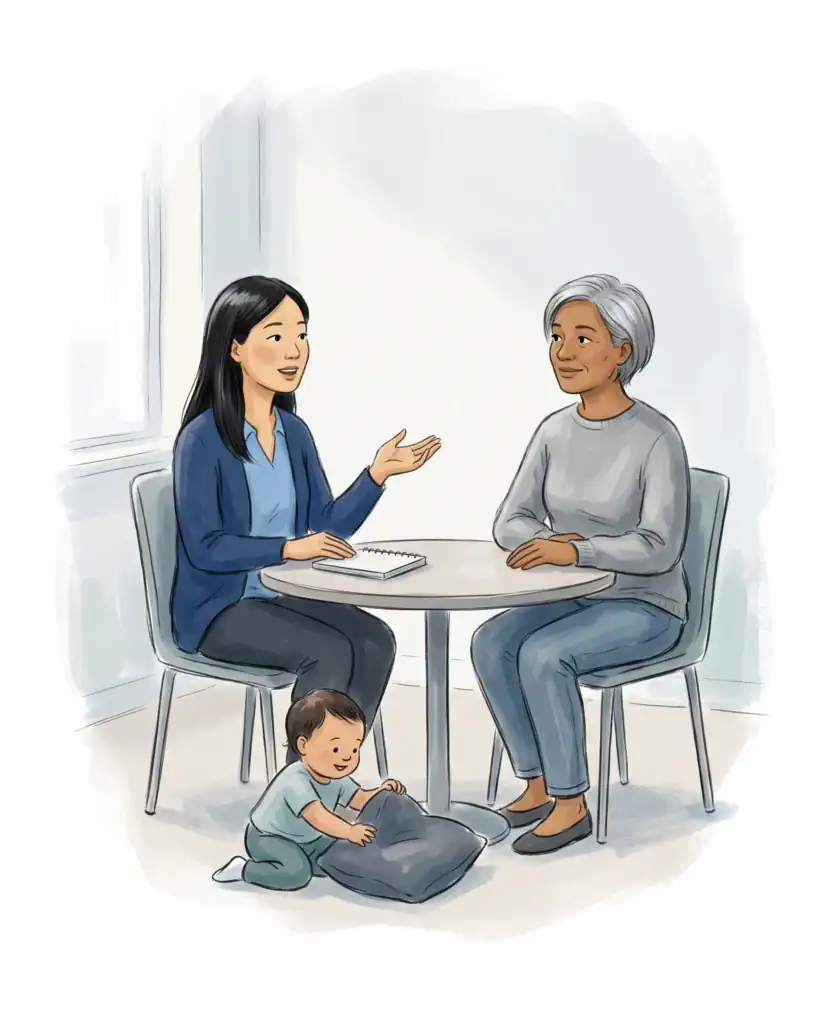
The Follow-Up is a short, structured conversation with a clinician, usually your child’s pediatrician or someone on their team. It covers only the items that scored on the questionnaire. For each of those items, the interviewer follows a set of clarifying questions, such as asking for examples or how often a behavior happens, to decide whether the item still shows elevated likelihood (M-CHAT-R/F instructions).
If two or more items still show elevated likelihood after the Follow-Up, the result is a positive screen. The scoring guide then calls for referral to early intervention and a diagnostic evaluation at the same time (scoring guide). If fewer than two items still score, the screen is negative, and routine developmental monitoring continues. Either way, keep raising any concerns you have.
High-likelihood score (8–20): straight to referral
A total of 8–20 means your child has screened positive. According to the scoring guide, the Follow-Up interview is not needed at this stage. Instead, the guide calls for referral right away for both early intervention and a diagnostic evaluation (scoring guide). The two can happen side by side, so you do not have to wait for one before starting the other.
This can feel like a lot to take in. A high score does not mean a diagnosis has been made. It means your child’s answers showed enough differences that a fuller evaluation is the recommended next step.
What a positive screen does and doesn’t mean
In the main validation study of the M-CHAT-R/F, about 16,000 toddlers were screened at 18- and 24-month well-child visits in metropolitan Atlanta and Connecticut. Among children who screened positive after the Follow-Up and were evaluated, 47.5% were diagnosed with autism, and 94.6% had some developmental delay or concern (Robins et al., 2014). Many of the children who were not diagnosed with autism had other developmental delays.
If screening or an evaluation confirms autism, our guide to autism support levels 1, 2, and 3 explains how a DSM-5-TR support level is assigned and how it can inform care planning.
Those numbers describe a research sample, not any one child. What they suggest is that a positive screen is worth acting on, because it often points to a developmental need, whether or not that turns out to be autism.
- A positive screen does not diagnose autism. A diagnosis comes from a comprehensive evaluation by a qualified clinician.
- It does not measure severity or predict how your child will do.
- It does not decide eligibility for services. Programs use their own evaluations and criteria.
- It can point to needs beyond autism, such as language or other developmental delays, which is why a broad evaluation, often including a hearing check, is helpful.
If speech is part of the picture, our guide to toddler speech delay vs. autism explains how clinicians tell the two apart. Some girls with subtle traits may not stand out on screening questionnaires; read more about how autism presents differently in girls.
Your first move: talk to your pediatrician
If your child scored in the moderate or high range, contact your child’s pediatrician soon. Ask what the score means for your child, which referrals they are making, and what you should do next. It can help to bring:
- The completed questionnaire and your child’s total score.
- Specific concerns, including when you first noticed them and how often they happen.
- Examples of how your child communicates, plays and interacts in different settings.
- A request for a clear plan for referrals and follow-up before you leave.
Call the Maryland Infants and Toddlers Program
If your child is younger than 3, you can contact the Maryland Infants and Toddlers Program yourself. Anyone who knows the child and has questions about their development can make a referral, including parents, relatives, child care providers and doctors. You can refer through the statewide referral site or by calling 1-800-535-0182. The program provides free, family-centered services to children with developmental delays or disabilities, and the program will contact you to learn more and schedule an evaluation (Maryland Infants and Toddlers Program).
Under federal early intervention rules, the initial evaluation, assessments and first planning meeting are generally completed within 45 days of the referral, unless the family needs more time or has not yet given consent (34 CFR 303.310). For children 3 and older, you can ask your local public school system for a free Child Find evaluation (CDC).
Why you don’t have to wait for a diagnosis to get help
Waiting lists for diagnostic evaluations can be long, and that wait can be stressful. The good news is that support does not have to wait. The CDC notes that you do not need a doctor’s referral or a medical diagnosis to request a free evaluation of your child’s development, and that treatment for specific needs, such as speech therapy for language delays, often does not need to wait for a formal autism diagnosis (CDC).
Early intervention focuses on the needs your child shows now, such as communication, play and daily routines, while any diagnostic evaluation moves forward. What services fit depends on your child’s evaluation and the program’s eligibility rules. For a fuller overview of how screening, evaluation and early intervention fit together, see our autism and early intervention guide.
Booking an autism evaluation in Maryland
A diagnostic autism evaluation is separate from early intervention. Your child’s doctor or insurance plan may have their own referral requirements. When you contact evaluators, it helps to ask:
- Who will complete the evaluation and what their credentials are.
- Which parts the evaluation includes, such as a caregiver interview, developmental history and a structured observation like the ADOS-2.
- How long the wait is, and whether there is a cancellation list.
- Whether they are in network with your plan and whether prior authorization is needed.
- When and how you will receive the written report and feedback.
Families looking for options can also search the Pathfinders for Autism provider directory. Our autism evaluations and diagnosis page explains how a comprehensive evaluation at Blue Sails works, including how the ADOS-2 can be one part of an assessment rather than a stand-alone answer. If an ADOS-2 is planned, our guide to preparing your toddler for the ADOS-2 explains what happens during the session and what the scores mean.
What to bring to your child’s evaluation
Autism is diagnosed by looking at development and behavior over time, so the information you bring helps the clinician see the full picture. Consider gathering:
- Medical and developmental records, including any prior evaluations or early intervention reports.
- Your child’s M-CHAT-R/F results, and any speech, hearing or vision results.
- Dated notes or short videos of communication, play or sensory reactions you see at home.
- A favorite toy or snack, any glasses or hearing aids, and your written questions.
How Blue Sails can help
Depending on your child’s age and needs, Blue Sails offers:
- Autism evaluations and diagnosis.
- Our early-intervention autism program for children ages 2 to 6, with ABA therapy planned with BCBA oversight. Program options and locations vary.
- Speech-language therapy.
- Parent coaching and training.
- Occupational and sensory therapy.
- Psychiatry for co-occurring concerns, when clinically appropriate.
Ask intake which services fit your child and what is currently available. For an overview, visit our autism services page or contact our intake team.
Frequently asked questions
Can I fill out the M-CHAT-R/F at home?
The authors make the M-CHAT-R/F available to download for free from the official M-CHAT website, though it remains a copyrighted tool with usage guidelines. If you complete it at home, share the answers with your child’s pediatrician, who can score it, complete the Follow-Up interview if needed and explain what the result means. (M-CHAT)
Is the M-CHAT-R/F available in Spanish or other languages?
Yes. The official M-CHAT website lists translations in many languages, including several Spanish versions, and some versions are specific to a country or region. Ask your pediatrician for the version that best fits your family’s language. (M-CHAT translations)
Can a daycare teacher fill out the M-CHAT-R instead of a parent?
The M-CHAT-R/F is designed as a parent-report tool, so it is meant to be completed by a parent or primary caregiver. A teacher’s observations can still help. Ask your child’s teacher for specific examples you can share with your pediatrician.
Does insurance cover an autism evaluation?
Blue Sails autism services accept Maryland Medicaid and TRICARE. Coverage varies by plan and service, and our team can check your benefits before you start. See insurance and billing for details.
Can my child’s M-CHAT-R score change between 18 and 24 months?
Yes, it can. Toddlers develop quickly, which is one reason autism-specific screening is recommended at both the 18- and 24-month visits. A low score at 18 months does not replace the 24-month screen, and any new concerns are worth raising at any time.