

Personality disorders are long-standing patterns in how a person experiences themselves, relates to others, and handles emotions and impulses. They are not character flaws, and they are not a reason to give up on care. This guide explains the treatment approaches with the strongest research base — especially dialectical behavior therapy (DBT) — and how schema therapy, mentalization-based treatment (MBT), and medication may fit when another condition is also present.
If you are in crisis or thinking about harming yourself, call 911, the nearest ER, or call or text 988.
This is a neutral educational overview, not a diagnosis and not a promise of a particular outcome. For signs, how care is structured, and how to start, see the personality disorders and BPD guide. To understand the patterns themselves, see specific personality disorders explained. For how temperament, attachment, and early adversity interact, see the developmental foundations of personality disorders.
Key Takeaways
- Psychotherapy is the central treatment for personality disorders. DBT is one of the best-studied approaches for borderline personality disorder (BPD), especially when reducing recurrent self-harm is a priority.
- Comprehensive DBT typically includes individual therapy, a skills group, between-session coaching, and a consultation team. A skills group alone is not the full program.
- Schema therapy and MBT are also studied approaches. Naming them is not the same as saying every clinic offers every model.
- Medication is not a general standalone treatment for a personality disorder. It may be considered for co-occurring conditions such as depression or anxiety.
- The NICE guideline on borderline personality disorder advises against using medication specifically for BPD symptoms themselves.
- Patterns can change. Change is not the same as a promised cure, and progress is often uneven.
What Makes a Treatment Evidence-Based?
In mental health care, “evidence-based” usually means an approach has been studied in controlled research, reviewed across multiple studies, and discussed in clinical guidelines. It does not mean the approach works the same way for every person, and it does not guarantee a timeline or a particular result.
For personality disorders, the research base is strongest for BPD. Studies of other specific personality disorders exist but are often smaller or less consistent. A careful plan still starts with a full assessment: which patterns are present, what else might explain them, what the person wants to change, and what support is available. For a broader look at how different talk therapies are used, see evidence-based psychotherapy modalities.
How DBT Works: Therapy Sessions Plus Skills Groups
Dialectical behavior therapy was developed for people with BPD, including those managing chronic suicidal thoughts or repeated self-harm. It combines acceptance — taking the person’s experience seriously — with change skills that help someone respond differently in hard moments. The NICE guideline recommends considering a comprehensive DBT program when reducing recurrent self-harm is a priority.
Comprehensive DBT typically has four parts:
- Individual therapy focused on personal goals, safety, and applying skills to real situations.
- A skills group that teaches four skill modules.
- Between-session coaching so skills can be used when distress is high, not only in the therapy room.
- A consultation team that supports the providers delivering the program.
Many programs also use diary cards to track emotions, urges, and skill use. Some people learn DBT skills alongside another therapy rather than entering a full program. Intake can explain which parts are available and which fit a particular situation. Blue Sails offers DBT; the hub page explains how to ask about delivery and fit.
Individual Therapy Sessions
Individual DBT sessions usually keep a clear target hierarchy. Life-threatening urges and behaviors come first, then anything that interferes with staying in treatment, then quality-of-life goals. The work often includes looking at what led up to a hard moment — sometimes called a chain analysis — and choosing a skill that could interrupt the next similar chain. Session frequency is adapted to a person’s needs; some programs consider more frequent sessions when safety or instability is high.
Group Skills Training
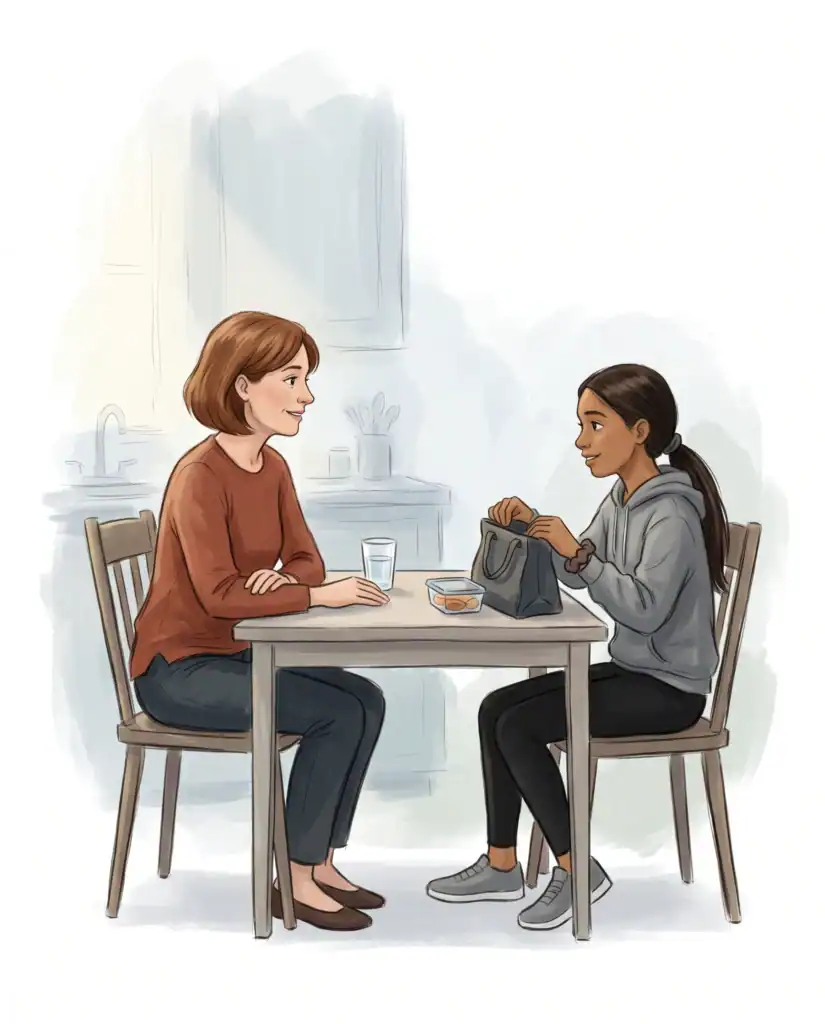
The skills group is a structured class, not a process group for sharing life stories at length. It is the place to learn and rehearse tools that individual sessions then apply to personal goals. The four modules are mindfulness, distress tolerance, emotion regulation, and interpersonal effectiveness. Two of those modules emphasize acceptance; two emphasize change. A typical meeting blends teaching, guided practice, and review of skills used between sessions.
Mindfulness: The Foundation Skill of DBT

Mindfulness in DBT means noticing the present moment, describing what is happening, and participating without immediately judging the experience as good or bad. The “what” skills are observing, describing, and participating. The “how” skills are practicing nonjudgment, one-mindfully, and effectively — doing what actually helps in this situation rather than what a feeling urges first.
Mindfulness is revisited throughout the curriculum because the other modules depend on it. A person cannot choose opposite action, ride out an urge, or make a clear request if they have not first noticed what they are feeling and what the situation actually is.
Distress Tolerance: Surviving a Crisis Without Making It Worse
Distress-tolerance skills are for moments when the goal is to get through a crisis without adding harm. They include self-soothing, distracting with intention, improving the moment, and radical acceptance — acknowledging reality as it is, not as a person wishes it were, so energy can go toward the next useful step.
These skills are not a treatment for the larger pattern on their own. They are tools for staying safer long enough to keep using the rest of the plan. If you cannot stay safe, call 911, the nearest ER, or call or text 988.
Emotion Regulation: Working With Intense Feelings
Emotion-regulation skills help a person name what they feel, reduce extra vulnerability (sleep, hunger, illness, and isolation can all make spikes more likely), and choose a response that fits the facts of the situation. Opposite action is used when a feeling is valid as a feeling but is prompting a behavior that would make things worse — for example, withdrawing from support when sadness is urging isolation, or attacking when anger is urging a blow-up.
Opposite action is not used to dismiss a justified feeling. The first step is still to name the emotion and check the facts. For people whose patterns involve avoidance, perfectionism, or a fragile sense of specialness as well as BPD traits, these skills are often combined with work on the beliefs driving the pattern. That overlap is one reason a full assessment matters.
Interpersonal Effectiveness: Healthier Relationships

Interpersonal-effectiveness skills are about asking for what is needed, saying no, and protecting self-respect while staying in relationship. DBT teaches structured ways to make a request or set a limit (often remembered with skill acronyms) and to do so without abandoning either the relationship or one’s own values.
Personality patterns often show up most clearly with other people. Skills here do not turn every relationship into an easy one. They give a person more options than silence, explosion, or giving in automatically.
Schema Therapy: Changing Lifelong Patterns
Schema therapy starts from the idea that unmet early needs can harden into lasting patterns — sometimes called schemas or modes — that shape how a person sees themselves and other people. The work combines cognitive and behavioral strategies with experiential techniques and a focus on the therapy relationship itself.
Research on schema therapy includes studies in people with BPD, and some programs use a mix of individual and group formats. It is typically described as longer-term work. The evidence base is smaller and less consistent than the DBT literature, and results vary. Schema therapy is named here as a studied approach, not as a service every clinic provides.
MBT: How Mentalization-Based Treatment Works
Mentalization is the ability to understand behavior — one’s own and other people’s — in terms of thoughts, feelings, and intentions. Under high emotion, that capacity can thin out, which makes impulsivity and relationship ruptures more likely. MBT sessions help a person notice when mentalizing has dropped and practice finding it again, especially in emotionally charged moments.
MBT is another researched option for BPD. Like schema therapy, it is not a replacement for a safety plan, and it is not a promised cure. A provider can explain whether they are trained in the model and why it might or might not fit.
Treatment for Personality Disorders Beyond BPD
Most of the controlled research on personality disorder treatment has focused on BPD. That does not mean other patterns are untreatable. It does mean the evidence looks different:
- For avoidant personality disorder, therapy often focuses on feared evaluation, gradual practice with connection, and the beliefs that make rejection feel certain. CBT is commonly discussed.
- For obsessive-compulsive personality disorder, therapy more often targets rigidity, standards, and the costs of control in work and relationships. This is not the same plan used for OCD. For OCD itself, see OCD treatment approaches.
- For narcissistic patterns, published psychotherapy research is more limited. Treatment, when it happens, is usually tailored to the person’s goals, sensitivity to criticism, and any co-occurring depression, anxiety, or substance use.
In each case, a clinician looks at the full picture rather than matching a label to a single protocol. Skills from DBT can still be useful when emotion dysregulation is part of the problem, even if BPD is not the primary diagnosis.
DBT, Schema Therapy, or MBT? How to Choose
There is no single best therapy for every person with a personality disorder. A useful choice conversation usually covers the main problem the person wants help with, the research behind each option, what the program actually includes, and whether the provider is trained in that model.
When recurrent self-harm or chronic suicidal thoughts are the priority, comprehensive DBT is the approach guidelines mention most directly. When the main difficulty is making sense of one’s own and others’ minds during conflict, MBT may be discussed. When long-standing beliefs about defectiveness, abandonment, or unrelenting standards feel like the core, schema therapy may be discussed. Those are starting points for a conversation, not a self-diagnosis algorithm.
Medication and BPD: What NICE Recommends
No medication is approved as a general treatment for personality disorders themselves. The NICE guideline on borderline personality disorder (CG78) says drug treatment should not be used specifically for BPD or for individual BPD-related behaviors such as repeated self-harm, marked emotional instability, risk-taking, or brief psychotic symptoms. It also advises against using antipsychotic medication as a medium- or long-term treatment for BPD.
NICE does allow clinicians to consider short-term sedative medication cautiously during a crisis, as part of an overall plan rather than instead of psychological care. If that option is used, the planned duration should be agreed in advance and kept short — the guideline says no longer than one week — and reviewed afterward. That is guideline language, not a house protocol and not a recommendation that someone start or stop a medication from an article.
If you are in crisis or thinking about harming yourself, call 911, the nearest ER, or call or text 988.
When Medication Makes Sense: Co-Occurring Conditions
Medication may still have a role when another condition is also present. Depression, anxiety disorders, PTSD, ADHD, bipolar disorder, and substance use can occur alongside a personality disorder, and each deserves its own assessment. Treating a co-occurring condition can make it easier to use therapy skills; it does not replace the therapy work on patterns, relationships, and identity.
Prescribing decisions belong with a psychiatric provider who knows the person’s history, other medications, and safety risks. For a neutral look at how talk therapy and medication can be coordinated, see combining talk therapy and medication management. For how Blue Sails structures DBT and related care, see the personality disorders and BPD guide.
Frequently Asked Questions
Does any medication treat a personality disorder by itself?
No medication is a general standalone treatment for a personality disorder. Medication may be used for co-occurring symptoms such as depression or anxiety, and NICE advises against using drugs specifically for BPD symptoms themselves. A psychiatric provider can explain whether medication is worth considering in a particular case.
What does a comprehensive DBT program include?
Complete DBT typically combines individual therapy, a skills group covering mindfulness, distress tolerance, emotion regulation, and interpersonal effectiveness, between-session coaching, and a consultation team for the providers. A skills group on its own is not the full program. Ask intake which parts are offered and how they are delivered.
How do schema therapy and MBT differ from DBT?
DBT teaches concrete skills and keeps a clear target hierarchy, with a strong research base for BPD and self-harm. Schema therapy focuses on long-standing patterns rooted in unmet early needs. MBT focuses on understanding thoughts and feelings — mentalizing — especially when emotion is high. All three are studied approaches; the better fit depends on goals, availability, and the provider’s training.
Can these treatments help if someone does not have BPD?
They can be part of a plan when the problems they target are present, such as emotion dysregulation, rigid standards, or difficulty reading one’s own and others’ intentions. The research is strongest for BPD. For other personality disorders, therapy is usually tailored, and a clinician should say what is known and what is not.
How can family members be involved?
Family involvement varies and should follow the person’s consent and privacy. Some programs include family or caregivers in skills work so new tools are not practiced only in isolation. Listening, taking feelings seriously, and supporting a professional assessment are often more helpful than trying to diagnose a loved one. If someone is in crisis or talking about suicide or self-harm, call 911, the nearest ER, or call or text 988.
Understanding treatment options can make a diagnosis feel less like a dead end and more like a map of skills and supports that can still be learned. For signs, how care is structured, and how to start, see the personality disorders and BPD guide. For day-to-day coping skills and family support, see coping with a personality disorder. If you or someone you love is in crisis, call 911, the nearest ER, or call or text 988.