
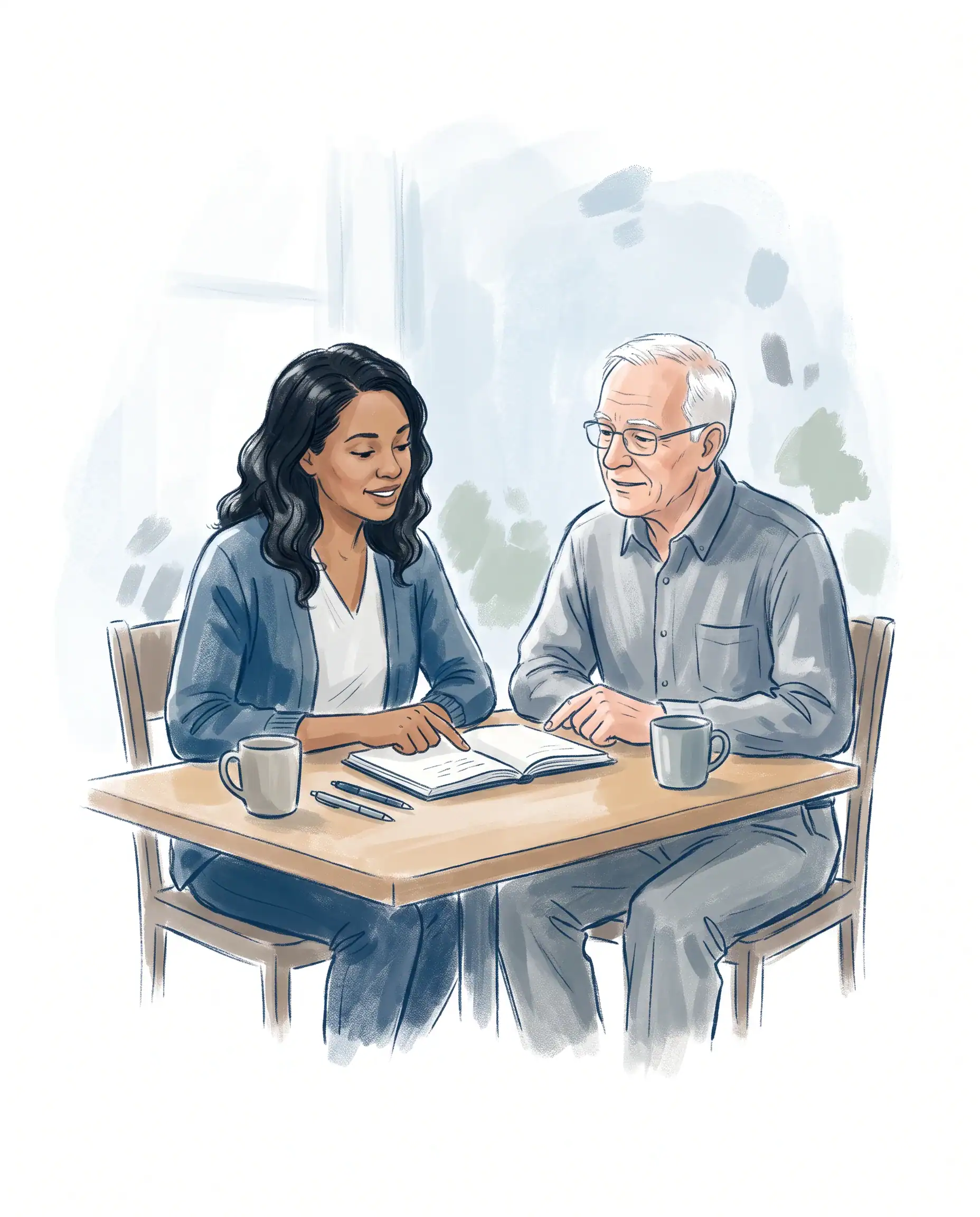
A personality disorder diagnosis describes long-standing patterns, not a person’s worth. Day to day, those patterns can show up as fast emotional shifts, a sharp fear of rejection, all-or-nothing views of other people, rigid standards, or a pull to withdraw even when closeness is wanted. This guide is about practical skills and supports — not a substitute for treatment and not a promise that any skill will work the same way for everyone.
If you are in crisis or thinking about harming yourself, call 911, the nearest ER, or call or text 988.
For signs, how care is structured, and how to start, see the personality disorders and BPD guide. For what the patterns look like, see specific personality disorders explained. For how comprehensive DBT and related treatments are structured, see evidence-based personality disorder treatment.
Key Takeaways
- Skills such as TIPP, mindfulness, radical acceptance, and clear boundaries can help a person get through hard moments. They complement therapy; they do not replace it.
- Rejection sensitivity and splitting (all-or-nothing shifts) are common in borderline personality disorder (BPD). Noticing them early makes it easier to choose a skill instead of a reaction that adds harm.
- Other personality patterns have their own daily strain: avoidance and feared criticism, rigid control, or a fragile sense of specialness after a slight.
- Family members can help by listening, validating feelings without immediately fixing or diagnosing, and keeping their own supports.
- A written crisis plan is easier to use than inventing steps in the moment. If you cannot stay safe, call 911, the nearest ER, or call or text 988.
What Living With These Patterns Can Feel Like
BPD is the pattern this guide names most often because much of the day-to-day skills literature was developed for it. People may describe emotions that rise quickly, a deep fear of being left, relationships that swing between closeness and conflict, and moments of emptiness or intense anger. Mood shifts are often tied to interpersonal stress and last hours more often than days.
Other personality disorders affect daily life too. Avoidant patterns can turn ordinary invitations into expected humiliation. Obsessive-compulsive personality disorder can make rest feel irresponsible and relationships take a back seat to getting things “right.” Narcissistic patterns can hide fragile self-esteem behind grandiosity, so criticism lands like a collapse. The skills below are described in BPD terms when that is how they were taught; many of them still help when the main struggle is intensity, rigidity, or withdrawal rather than a BPD diagnosis.
Handle Rejection Sensitivity Without Adding Harm
Many people with BPD expect rejection and feel excluded more intensely than the situation may warrant. That expectation can be accurate in some relationships and overstated in others. The skill is not to talk yourself out of the feeling. It is to notice the surge, check the facts, and choose a response that does not burn a bridge you still want.
Helpful pauses include asking what evidence supports the feared rejection, what evidence does not, and what a wise next step would be if both could be partly true. Reaching out for clarification is often safer than disappearing or attacking. If the urge is to self-harm, the crisis plan and TIPP skills below come first.
Manage Splitting When Feelings Flip Fast
Splitting is an all-or-nothing shift: someone who felt safe this morning can feel dangerous by afternoon, or a person can move from “I am fine” to “I am unlovable” after one text. The flip is real as an experience. It is not a reliable verdict about the other person or about oneself.
Naming the shift — “this feels like all-or-nothing thinking” — creates a little space. Dialectical thinking, a core DBT idea, holds that two things can be true at once: a person can be hurt and still care, or angry and still want the relationship. When these flips keep disrupting important relationships, working them through with a DBT-trained provider gives structured practice that an article cannot provide.
Use TIPP Skills to Survive Emotional Crises
TIPP is a set of DBT distress-tolerance skills for when emotion is so high that thinking clearly is difficult. The aim is to change body chemistry enough to ride out the peak without adding harm, not to solve the larger problem in that minute.
- Temperature: a brief change in temperature, such as cool water on the face, can interrupt an emotional spike for some people. Anyone with a medical condition that makes sudden cold unsafe should ask a clinician before using this skill.
- Intense exercise: short, vigorous movement can discharge adrenaline when the body is revved up. It is not a workout plan and should stay within what is medically safe.
- Paced breathing: slowing the breath, especially lengthening the exhale, can bring the nervous system down a notch.
- Progressive relaxation: tensing and releasing muscle groups gives the mind a concrete task and the body a chance to stand down.
TIPP is a crisis skill, not daily treatment. If you cannot stay safe, call 911, the nearest ER, or call or text 988.
Try Radical Acceptance to Ride Out Impulsive Urges
Radical acceptance means acknowledging reality as it is in this moment, including pain you did not choose. It is not approval, forgiveness, or giving up. It is the step that frees energy from fighting “this should not be happening” so a person can choose the next useful action.
When an urge to lash out, disappear, or self-harm is strong, acceptance sounds like: this urge is here; I can notice it; I do not have to obey it. Pairing acceptance with a distress-tolerance skill is often more useful than arguing with the urge.
Practice DBT Mindfulness in Daily Life
Mindfulness in DBT means observing what is happening, describing it in words, and participating in the present moment without immediately judging it. The “how” skills — nonjudgment, one-mindfully, and effectively — keep the practice from turning into another way to criticize oneself.
A short daily practice might be noticing the breath for one minute, describing an emotion without adding a story, or doing one ordinary task with full attention. Mindfulness does not make feelings smaller on command. It makes them easier to see, which is what the other skills require. For how these modules fit inside a full DBT program, see evidence-based personality disorder treatment.
Build a Crisis Plan Before You Need It
Identify Triggers and Patterns
A useful plan starts with what tends to set off a spiral: perceived criticism, last-minute changes, feeling left out, conflict at night, missed sleep, or anniversary dates. Write down early warning signs as well — talking faster, scanning texts, feeling unreal, or thinking in extremes — so the plan can start before the peak.
Plan Coping Steps
List skills in order, from smallest to strongest: a TIPP skill, a person it is safe to text, a place that helps you reset, and the professional contacts who already know you. Include the exact crisis wording you may need later: if you are in crisis or thinking about harming yourself, call 911, the nearest ER, or call or text 988. Share the plan with one trusted person if that feels safe, and review it after a hard day rather than only in the middle of one.
Set Boundaries That Support Recovery
Boundaries are clear statements about what a person can do, not punishments. For someone living with these patterns, they might sound like: “I want to keep talking, and I need a 20-minute pause so I do not say something I cannot take back.” For a family member, they might sound like: “I can listen for the next ten minutes, and I cannot stay on the phone if threats continue. I will help you get crisis support instead.”
Good boundaries are specific, repeatable, and paired with what you will do. They protect the relationship more often than they end it. They are not a substitute for a safety plan when risk is high.
Use SET to Defuse Heated Conversations
SET is a family-communication approach often taught in BPD education: Support, Empathy, and Truth. Support names care (“I am here and I want to understand”). Empathy names the feeling without having to agree with every interpretation (“It makes sense that you felt left out”). Truth adds the reality the speaker also needs to hold (“I cannot cancel this appointment, and I can talk at 7”).
The order matters. Truth without support and empathy often lands as rejection. Support without truth can become rescuing. This is a conversation skill, not a way to control another adult, and it works better when both people are not at peak distress.
How Family Support Can Help
Family support does not “speed recovery” on a timer. What it can do is reduce extra conflict, make skills easier to practice, and keep everyone safer. Listening calmly, taking feelings seriously, and avoiding instant diagnosis or debate are often more useful than trying to talk someone out of a feeling.
Validation is not the same as agreeing that a feared interpretation is true. A person can say “I hear how abandoned that felt” without accepting blame for something they did not do. Encouraging professional care, keeping your own limits, and making a plan for crisis moments in advance all help more than last-minute improvising.
Get Support for Caregiver Burnout
Supporting someone with intense emotions is hard work. Exhaustion, guilt, irritability, and walking on eggshells are common and are not proof of failure. Caregivers do better with their own supports: a separate provider, a trusted friend, rest that is actually rest, and education from reputable family resources rather than from comment threads.
You cannot do another person’s treatment for them. You can stay in relationship, keep limits, and get help for yourself. If your loved one is in crisis or talking about suicide or self-harm, call 911, the nearest ER, or call or text 988.
When Other Personality Disorders Affect Daily Coping
The same week can look different depending on the pattern. Someone with avoidant personality disorder may need graded practice with connection rather than TIPP for a rage spike. Someone with OCPD may need permission to stop a task that is “not done enough.” Someone with narcissistic patterns may need help naming shame after criticism without covering it with contempt. In each case, the daily work is noticing the protective strategy and choosing a smaller, safer next step. A clinician can help match skills to the actual pattern.
How to Find Support in Maryland
Skills articles are not a clinic. If long-standing patterns in emotions, identity, or relationships keep getting in the way of daily life, talk with a provider about assessment and whether DBT or another approach fits. The personality disorders and BPD guide explains how Blue Sails structures that conversation and how to start. For how temperament and early experience relate to these patterns, see foundations of personality disorders.
Frequently Asked Questions
Can medication alone treat borderline personality disorder?
No. Medication is not a general standalone treatment for a personality disorder. Psychotherapy such as DBT or CBT is the central treatment. Medication may help co-occurring conditions such as depression or anxiety. The treatment guide summarizes what NICE says about medication and BPD.
What is the difference between BPD and bipolar disorder?
Both can involve intense mood changes, but the pattern differs. In bipolar disorder, mood episodes usually last days to weeks and include changes in sleep need and energy. In BPD, mood shifts are often briefer and closely tied to relationship stress. The two can also occur together. See Bipolar I vs Bipolar II vs cyclothymia and specific personality disorders explained.
How common are personality disorders?
Estimates vary by study method. According to the National Institute of Mental Health, about 9.1% of U.S. adults met criteria for any personality disorder in a given year in the National Comorbidity Survey Replication, and about 1.4% met criteria for BPD. Those are past-year survey estimates, not a prediction about any one person.
Can someone fully recover from a personality disorder?
Patterns can be long-standing and still change. Many people no longer meet full diagnostic criteria after a period of recovery, though relationships and work may shift more slowly than individual symptoms, and setbacks can happen. “Change” is not the same as a promise of a cure.
How can family members help without taking over?
Listen, validate feelings, keep limits, and support professional care rather than trying to be the treatment. Use SET when conversations run hot, and get support for yourself. If someone is in crisis, call 911, the nearest ER, or call or text 988.
Living with a personality disorder is not the same as being beyond help. Skills, clear boundaries, and the right kind of support can make daily life more workable while treatment addresses the larger pattern. For how to start, see the personality disorders and BPD guide. If you or someone you love is in crisis, call 911, the nearest ER, or call or text 988.