
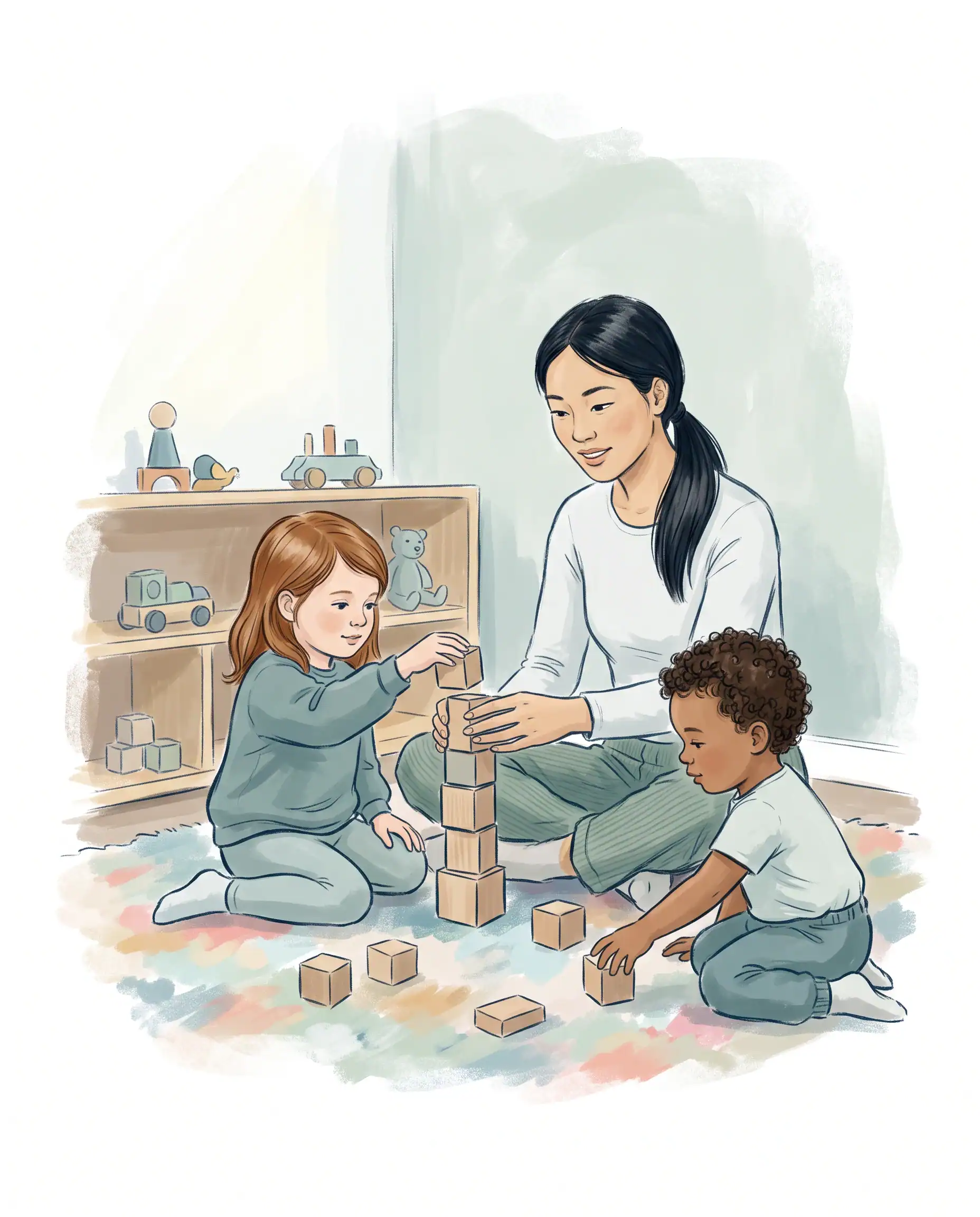
Play therapy for children is a structured psychotherapy approach that uses toys, sand trays, puppets, art, and pretend play as the main language of the session. Young children often show distress through behavior before they can explain feelings in adult words, so a licensed clinician trained in play therapy watches themes in play, reflects feelings, and keeps the room safe with clear limits.
This Insights guide is a neutral how-to: why talk alone is hard for many young children, what makes play therapy different from everyday play, what a playroom session can look like, how research is usually described for anxiety, family change, and trauma-related concerns, the parent role, and how to vet a qualified clinician. It is educational, not medical advice, and does not replace care from your own Provider. For Blue Sails pathways, see child play therapy and expressive therapy, counseling for elementary school children, children and adolescents, outpatient therapy, and evidence-based therapy modalities.
If you are in crisis, call 911, go to the nearest ER, or call or text 988. Blue Sails is not an emergency service.
Key Takeaways
- Play therapy follows a clinical model with goals—it is not the same as spontaneous free play at home or school.
- Young children often communicate through behavior and play before they can label complex feelings in words.
- Licensed clinicians with play-therapy training observe themes, nonverbal cues, and the child’s lead (or guided activities) while keeping firm safety limits.
- Research reviews of child-centered and related play approaches generally report moderate benefits for some emotional and behavioral concerns; results vary and are not guaranteed.
- Parents are partners in history, goals, and home carryover; session details stay confidential within safety and legal limits.
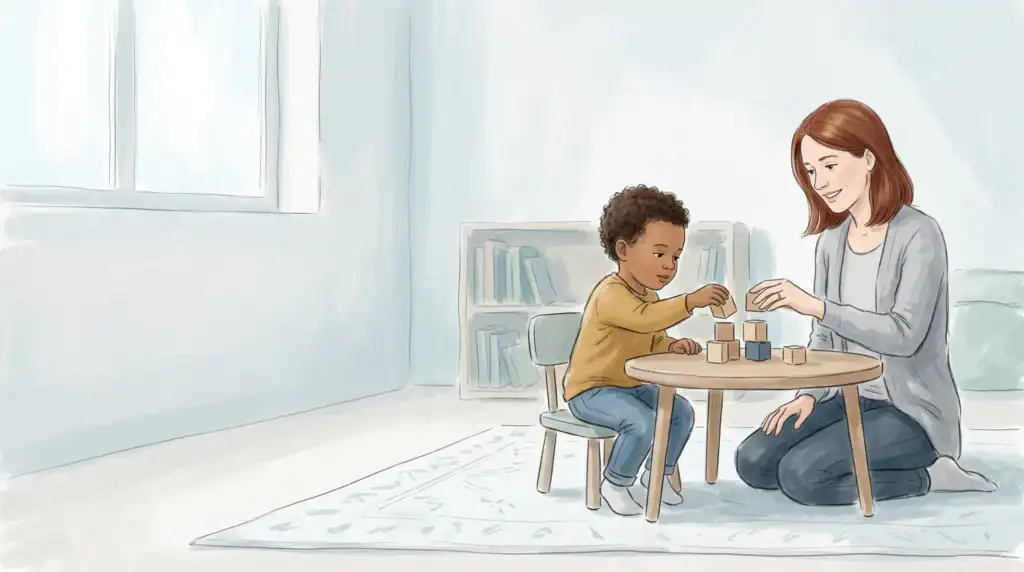
Why Young Children Can’t Just Talk About Their Feelings
Naming a feeling takes more than feeling it. A child has to connect body cues and situations to a word, and that skill grows over time. Developmental research often describes emotion labeling as emerging gradually across early childhood and the school years—approximate ages in studies are research context, not Blue Sails eligibility rules or clinical cutoffs. Limited explanation never means limited feeling.
Meanwhile, brain systems that pause strong feelings and find words keep maturing well beyond the preschool years. Overwhelmed children commonly show distress through behavior first. Toys and sand trays give another channel when talk is not yet enough. A predictable daily routine can also help a child feel more secure while new skills are practiced at home and in session.
Related reading for families comparing modalities: therapy modalities overview and the service page for play and expressive therapy.
What Makes Play Therapy Different From Just Playing?
On the surface, a play therapy session can look like ordinary fun. The difference is trained clinical guidance and purposeful play tied to emotional, behavioral, or developmental goals. Every toy, game, and interaction is chosen or observed to help a child work through specific challenges—not because any enjoyable activity automatically counts as therapy.
Like other creative approaches, play therapy can help children express emotions and connect experiences with coping. Creative activities such as storytelling and painting are tools inside a clinical relationship, not hobbies alone. Play therapy can also sit alongside other youth mental health care—including outpatient therapy or psychiatry when clinically appropriate—without replacing those services.
Trained clinician guidance
A toy kitchen, sand tray, or pile of crayons can look identical in a daycare or a therapy office. What happens around them is different. Licensed clinicians with specialized play-therapy training read children’s play the way they listen to words. They also notice nonverbal cues—a clenched fist, a hesitant pause—and use attunement so hard feelings can be approached safely.
Credential questions worth asking include graduate training and an active mental-health license, documented play-therapy instruction and supervised experience with children, and renewal of any play-therapy credential. Directories such as the Association for Play Therapy help parents verify Registered Play Therapist (RPT) standing when that credential is claimed.
Purposeful play with goals
Ordinary play is spontaneous. Play therapy follows a theoretical model and ties sessions to identified aims—naming feelings, practicing regulation, rehearsing coping with anxiety-provoking situations, or working through a family change. In child-centered play therapy, the child leads and the clinician follows, reflecting feelings and setting gentle limits. In more directive approaches, the clinician guides activities aimed at a specific skill. Many Providers blend both based on the child’s needs.
Emotional labeling can make feelings less overwhelming when it grows from the child’s pace. Symbolic play can let a child rehearse alternative responses. Those ideas echo Axline’s classic child-centered principles: when a clinician recognizes feelings and reflects them back, the child can gain insight into their own behavior. Outcomes still vary by concern, dose, and fit.

Inside the Playroom: Sand Trays, Puppets, and Symbolic Play
A typical playroom may include sand trays with miniature figures, puppets, dolls, building toys, and art materials. Children who cannot yet say “I’m scared” or “that made me angry” can show what they are carrying through scenes and stories.
Sand trays tell stories
Sand can hold what words cannot yet carry. Children arrange figures and objects into scenes that express experiences they struggle to explain. Creating a scene also gives choice and agency—the child shapes the story. Clinicians explore themes over time rather than imposing a fixed “code” (a dragon does not mean one universal thing). Sandplay is a therapeutic activity, not a stand-alone diagnostic test. Research suggests meaningful emotional benefits for some children, though the evidence base remains limited compared with some talk therapies for older youth.
Puppets unlock emotional expression
Distance creates safety. When a child speaks through a wolf or a shy rabbit, the puppet becomes a stand-in, so difficult feelings can surface indirectly. That buffer often feels less exposing than naming struggles out loud. Movement, sound, and gesture offer nonverbal routes too. In child-led work, the clinician follows the child’s lead, reflects feelings, and lets the story reveal what needs attention—without forcing a confession.
Does Play Therapy Help With Anxiety, Family Change, and Trauma?
Research on play therapy is promising for many families, though study quality and samples vary. Meta-analytic reviews of child-centered play therapy and related approaches generally report moderate benefits for some internalizing and externalizing symptoms; treat published effect sizes and study counts as orientation for a conversation with a clinician, not as a personal outcome promise. There is no single study count that “proves” play therapy for every child.
Anxiety disorders in children and teens can affect daily life, so early identification and mental health evaluation matter. For school-related anxiety or refusal, clinicians may coordinate with schools on supports such as 504 Plans or IEPs when appropriate. Family change (including separation or divorce) studies sometimes show improved adjustment, though samples are often small. Trauma-related work should be paced carefully; if trauma overwhelms your child, call 911, go to the nearest ER, or call or text 988. When anxiety or depression causes persistent school impairment or severe sleep disruption, a psychiatric evaluation may be discussed alongside therapy.
Imagine common session moments: a child stacking blocks while naming worries; a dollhouse where a miniature figure moves between two homes; puppets voicing fears a small voice cannot yet say; a sand tray where a buried figure slowly resurfaces; drawings of storms that calm across sessions. Those vignettes illustrate process—not guaranteed milestones.

What Do Parents Do in Play Therapy?
Parents often have a bigger role than they expect. Many clinicians meet caregivers first—without the child—to gather history, explain the process, and set shared goals. Periodic check-ins (for example every several sessions) let parents report changes at home or school while the clinician reviews the plan. Exact schedules vary; some practices also review treatment plans on a regular cadence such as every few months.
The exchange runs both ways. Parents know routines and relationships; clinicians see playroom patterns. Strategies may be suggested for calmer home moments, while the child keeps protected play space within safety limits. Parents handle logistics; clinicians handle the clinical process. Together they connect both. A supportive family atmosphere can strengthen relationships and help progress carry over—without turning parents into unpaid co-therapists.
How to Find a Qualified Play Therapist
Two non-negotiables: an active mental-health license and documented play-therapy training. A general therapist title does not guarantee child-specific training. The Association for Play Therapy promotes credentialed play therapists and offers a directory parents can use before booking.
When you evaluate candidates, ask about:
- Registered Play Therapist (RPT) credential status, if claimed, verified through APT
- Documented play-therapy instruction and supervised clinical experience with children
- Direct experience with your child’s developmental stage and concerns (anxiety, grief, trauma, family changes)
- Continuing education and license renewal
- Setting fit: outpatient clinic, private practice, school-based care, or telehealth when clinically appropriate
In Maryland, clinicians may hold licenses such as LCSW-C or LCPC—confirm that the license and training fit your child’s needs. For school-aged children, ask whether the clinician can coordinate with school and support a 504 Plan or IEP when appropriate. Ask directly: “What active license authorizes this work, and is any play-therapy credential current?” The right clinician welcomes these questions.
Finding Care in Maryland
Look for licensed Providers who can explain options in plain language, track progress with you, and adjust if the fit is poor. You do not need to pick a modality before intake.
Blue Sails offers play and expressive therapy, elementary-age counseling that can include play therapy, child and adolescent care, outpatient therapy, and telehealth counseling when clinically appropriate. Offices include Rockville and Lusby, plus statewide telehealth. Meet the clinical team and review new patient steps when ready. Call (410) 231-0488 or use client intake; please do not email clinical details. Blue Sails accepts TRICARE and other insurance generally; verify your plan with intake. See insurance and billing and FAQs.
If you are in crisis, call 911, go to the nearest ER, or call or text 988. Blue Sails is not an emergency service.
Frequently Asked Questions
How many play therapy sessions does a child typically need?
Course length varies widely. Many families continue for several months of weekly sessions; some children need fewer meetings and others need longer work depending on concern severity, stability at home and school, and treatment goals. There is no firm universal session count that fits every child. Your clinician should revisit progress and the plan with you rather than promising a fixed count.
Is play therapy covered by insurance?
Insurers often cover psychotherapy when medically necessary, though coverage depends on your plan. Play therapy is usually billed under standard psychotherapy codes rather than a unique “play therapy” code. Verify benefits, ask which CPT codes apply, and confirm network status with intake. See insurance and billing.
What should I tell my child before the first session?
Keep it simple and honest: they will meet a caring helper who understands big feelings; they can play or talk; you will stay nearby as arranged; and coming to therapy does not mean they did something wrong.
Will the clinician share what my child does in sessions?
Generally, specific session details stay confidential to protect the child’s safety to explore. Clinicians typically share progress updates covering broad themes, goals, and behavioral changes, plus scheduled parent consultations—unless safety concerns or legal duties require disclosure.
Can play therapy be delivered through telehealth?
Some play-informed work can happen by telehealth, often with a caregiver coaching materials at home, and it tends to fit better for some older children than for the youngest. Many young children still do better in a dedicated playroom. Ask what your clinician recommends. Maryland options are described on statewide telehealth counseling.
Sources: Association for Play Therapy, NIMH — Child and adolescent mental health, NIMH — Psychotherapies, Evidence-Based Child Therapy (play therapy research summaries), CDC — Children’s mental health, 988 Suicide & Crisis Lifeline. Information is current as of November 2026 and may change. Confirm clinical questions with your Provider. This article is educational and does not create a treatment relationship.