

Attachment styles describe the patterns people bring to close relationships: how they seek comfort, how they react when a partner seems distant, and how much closeness feels safe. Adults are often described as secure, anxious, avoidant, or disorganized (also called fearful-avoidant). These are ways of describing learned strategies, not diagnoses, and they can shift over time. Researchers use the term earned security for adults who move toward a more secure way of relating after difficult early experiences.
This guide explains where the four styles come from, the two dimensions that sit underneath them, why anxious and avoidant partners so often get stuck together, and what tends to help. For a broader overview of communication, boundaries, family and teen support, see the relationships and family guide.
Key Takeaways
- Adult attachment is usually measured on two dimensions: attachment anxiety (worry about rejection or a partner’s availability) and attachment avoidance (discomfort with closeness and depending on others).
- Secure, anxious, avoidant and fearful-avoidant styles are shorthand for combinations of those two dimensions. Most people are a blend.
- Attachment styles are not DSM-5-TR diagnoses. Self-report quizzes describe tendencies; they do not diagnose anyone.
- Anxious and avoidant strategies can lock partners into a pursue-withdraw cycle in which each person’s protection feels like a threat to the other.
- Patterns are fairly stable but not permanent. Supportive relationships, reflection and therapy can help security grow, though no particular result can be promised.
What Is Attachment? A Quick Foundation
Attachment theory began with John Bowlby’s work on how infants stay close to caregivers for comfort and protection. Mary Ainsworth’s observational studies described secure and insecure patterns in young children, and later researchers added a disorganized pattern. In 1987, Cindy Hazan and Phillip Shaver applied attachment ideas to adult romantic love, proposing that partners can become attachment figures for each other.
Early caregiving shapes expectations about whether comfort will arrive when someone is distressed. Those expectations are only part of the story. Later friendships, romantic relationships, losses, culture and temperament all add to the picture, and research following children into adulthood finds that early attachment explains only some of the differences between adults. Difficult early experiences raise the likelihood of insecurity; they do not decide it.
The Two Dimensions Behind the Four Styles
Modern adult attachment research usually describes two continuous scales rather than four boxes:
- Attachment anxiety: how much a person worries about rejection or abandonment and watches for signs that a partner is pulling away.
- Attachment avoidance: how uncomfortable a person feels with closeness, emotional disclosure and relying on others.
Combining the two gives the four familiar styles, an approach associated with Kim Bartholomew and Leonard Horowitz’s four-category model:
- Secure (low anxiety, low avoidance): comfortable with closeness and with independence; able to ask for support and to offer it. Secure people still argue and misread each other, but conflict does not feel like a threat to the bond.
- Anxious or preoccupied (high anxiety, low avoidance): strong need for reassurance, close attention to small signs of distance, and distress when a partner goes quiet.
- Avoidant or dismissive (low anxiety, high avoidance): a pull toward self-reliance, reluctance to share vulnerable feelings, and stepping back when things feel intense.
- Fearful-avoidant or disorganized (high anxiety, high avoidance): wanting closeness while also fearing it, so that both moving toward and away from a partner can feel unsafe.
Because these are scales, two people with the same label can look quite different, and the same person may lean anxious with one partner and more avoidant with another.
Spotting Your Own Patterns

Online attachment style quizzes are popular, and research questionnaires do exist. The Experiences in Close Relationships–Revised (ECR-R) scores anxiety and avoidance separately, and shorter versions are used in research. Clinicians and researchers may also use interviews, such as the Adult Attachment Interview, which looks at how coherently a person can talk about early relationships. These tools describe tendencies; none of them diagnoses a mental disorder.
A practical self-check is to look for repeated patterns rather than one bad week. Questions that can help:
- When a partner is slow to reply or seems distracted, do you tend to reach out harder, or pull back and go quiet?
- When you feel hurt, is it easier to protest, to shut down, or to say what you need?
- Do you trust that a partner will still be there after a disagreement?
- Does closeness feel comforting, crowding, or both at once?
The aim is understanding, not a verdict about yourself or a partner. Attachment anxiety is also different from an anxiety disorder: one describes relationship-focused worry, the other a pattern of symptoms that affects many areas of life. If worry or low mood is spreading well beyond the relationship, a clinical assessment can help sort out what is going on; the anxiety care guide explains more.
Why Anxious and Avoidant Partners Trigger Each Other
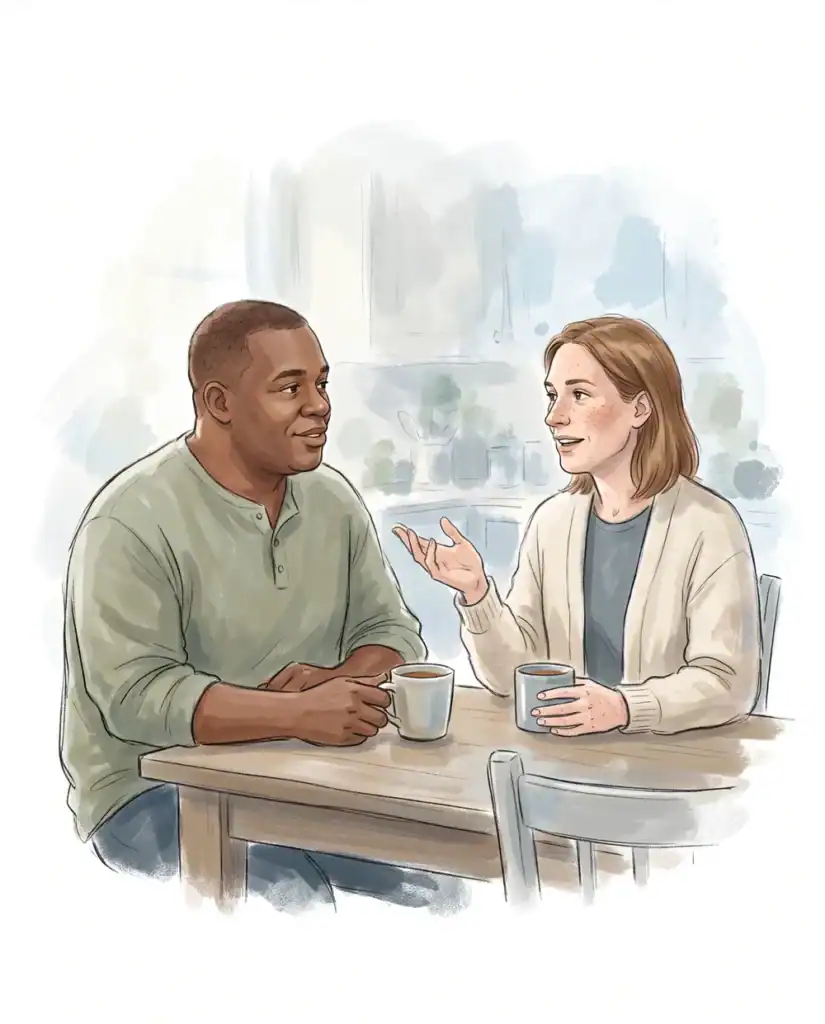
One of the most common relationship cycles is often called pursue-withdraw or demand-withdraw. A partner who leans anxious hears silence or disagreement as possible rejection and pursues: pressing to talk, criticizing, or asking for reassurance. A partner who leans avoidant feels that pursuit as pressure and withdraws: going quiet, changing the subject, or leaving the room. Each response makes sense from the inside, and each one feeds the other.
| Anxious-leaning partner | Avoidant-leaning partner | What both may feel |
|---|---|---|
| Seeks reassurance | Minimizes the problem | Unheard |
| Reads distance as danger | Reads requests as pressure | Under threat |
| Escalates to be noticed | Retreats to calm down | Alone in the relationship |
Over time the argument stops being about the dishes or the text message and becomes about the cycle itself: pursuit reads as control, withdrawal reads as abandonment. The roles are not fixed by gender, and they can flip; an anxious partner may withdraw to avoid rejection, and an avoidant partner may push hard when cornered. Naming the cycle together, without blaming one person, is usually the first step. The Gottman Method describes related warning signs, including criticism, contempt, defensiveness and stonewalling.
Not every painful pattern is an attachment mismatch. Fear of a partner, threats, control over money or contact, or pressure around sex call for a safety-first response rather than work on communication styles; the relationships and family guide explains when safety comes first.
Can You Earn a Secure Attachment Style?
Attachment patterns tend to be fairly stable, but they are not permanent. Studies that follow adults over time suggest that attachment anxiety and avoidance can shift with life events, new relationships and reflection. Earned security is the term researchers use for adults who describe insecure early relationships but now talk about them in a coherent, balanced way and relate to others with more security.
Change usually comes gradually, through many repeated experiences of consistent, responsive connection rather than a single insight. In everyday terms it may look like:
- For anxious patterns: noticing the urge to seek reassurance, pausing, and making a direct request (“Can we talk tonight? I’m feeling disconnected”) instead of escalating.
- For avoidant patterns: staying present a little longer when closeness feels uncomfortable, and naming the need for a break with a time to come back.
- For fearful-avoidant patterns: building safety first, often with support, because both closeness and distance can stir old fear.
Reflection, supportive friendships and a steady partner can all help. Therapy is one place to practice these skills deliberately. No approach can promise a specific outcome or timeline.
How Couples Therapy Works With Attachment
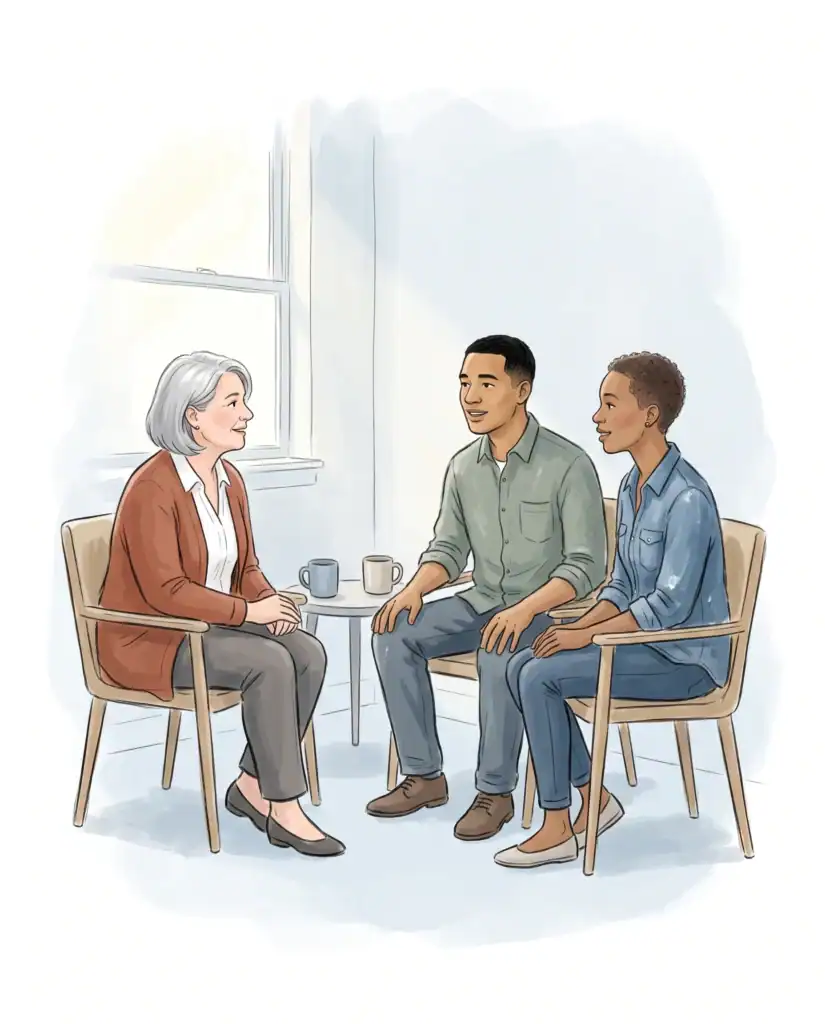
Emotionally focused therapy (EFT) treats many couple conflicts as protests about emotional disconnection. It is usually described in three stages: de-escalating the negative cycle by mapping it together, restructuring the bond as partners share the more vulnerable feelings beneath anger or shutdown and respond to each other differently, and consolidating the new patterns. The Gottman Method focuses more on friendship, conflict skills and repair attempts. Many clinicians draw on both. For a closer look at how the two compare, see how Gottman and EFT couples therapy repair trust and communication.
How Individual Therapy Can Help
Attachment work does not require a partner in the room. In individual therapy, the relationship with a consistent, nonjudgmental clinician can itself become a secure base for exploring old expectations about closeness, dependence and worth, and for testing whether they still fit. Emotion regulation skills and reflection help attachment fears steer reactions less automatically. Approaches vary, including psychodynamic, cognitive behavioral and trauma-informed therapies. When painful early experiences still shape how closeness feels, trauma-informed care can move at a manageable pace; see healing from complex trauma and adverse childhood experiences the trauma and PTSD guide, and trauma and PTSD therapy options. For how early attachment relates to longer-standing personality patterns, see the developmental foundations of personality disorders.
When to Seek Professional Support
It may be worth talking with a provider when the same conflict cycle keeps repeating despite real effort, when fear of rejection or of closeness is affecting sleep, work or friendships, or when past experiences make it hard to feel safe with anyone. Blue Sails describes how individual, couples and family sessions work on its couples counseling and family therapy page and its individual psychotherapy page. To start, use client intake or contact the team. If you or someone you love is in crisis or thinking about self-harm, call 911, the nearest ER, or call or text 988.
Frequently Asked Questions
Can you have both anxious and avoidant traits at the same time?
Yes. Adult attachment is measured on two separate dimensions, anxiety and avoidance, so a person can score high on both. That combination is often called fearful-avoidant or disorganized attachment: wanting closeness while also fearing rejection or being hurt.
Is attachment anxiety the same as an anxiety disorder?
No. Attachment anxiety describes relationship-focused worry about rejection or a partner’s availability. An anxiety disorder is a clinical diagnosis involving symptoms that cause distress or impairment across areas of life. If worry is affecting work, sleep or health, a clinical assessment can help.
How do providers assess adult attachment styles?
Researchers and clinicians may use self-report questionnaires such as the Experiences in Close Relationships–Revised, or interviews such as the Adult Attachment Interview. These describe attachment patterns on a spectrum. They are not used to diagnose a mental disorder.
Do attachment styles change from one relationship to another?
Attachment styles tend to be fairly stable, but they are not fixed. A person may relate more securely with one partner than another, and major life events, new relationships, reflection and therapy can all shift patterns over time. Change is possible but not guaranteed.
What is earned secure attachment?
Earned security describes adults who had insecure or difficult early relationships but have come to understand those experiences in a coherent way and now relate to others with more security. It usually develops gradually through supportive relationships, reflection, and sometimes therapy.
Sources
Sources: Hazan & Shaver (1987), Journal of Personality and Social Psychology, Fraley, Experiences in Close Relationships–Revised, ICEEFT — What is EFT, The Gottman Institute — The Four Horsemen.